
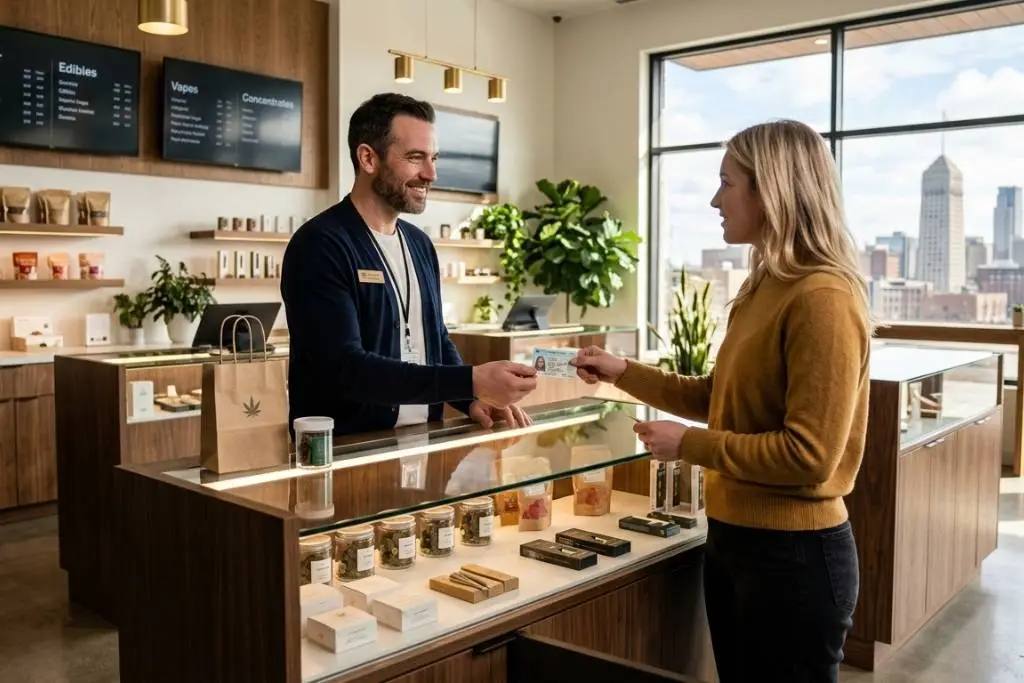
The legalization of adult-use cannabis in Minnesota on August 1, 2023, initiated a profound transformation across the state’s economic and regulatory landscape. Indeed, industry analysts observe a steady, structured expansion of retail networks designed to serve both therapeutic and recreational consumers. Consequently, understanding the precise operational boundaries of a Minnepolis Dispensary represents a critical step for consumers seeking safe, legal, and compliant access to tetrahydrocannabinol (THC) and other cannabinoid formulations.
This comprehensive report examines the current state of Cannabis Minneapolis, detailing the legislative frameworks, purchase limits, and market dynamics that define the region. Furthermore, with the recent integration of adult-use and medical supply chains, the local market exhibits unique structural characteristics that benefit the consumer. Specifically, individuals looking to procure high-quality options can navigate the premier selections available at the online Cannabis Minneapolis cannabis products of weedinminnesota.com, which facilitates streamlined Minneapolis dispensary delivery and retail pickup.
What is a Minnepolis Dispensary?
A Minnepolis Dispensary represents a state-authorized or tribal-governed retail venue licensed to sell recreational or medical cannabis products to qualified individuals. Generally speaking, these facilities operate under strict compliance metrics established by the Minnesota Office of Cannabis Management (OCM) or sovereign tribal authorities. Moreover, the storefronts provide a controlled, educational environment where certified specialists, commonly known as budtenders, guide consumers through diverse product lines.
These establishments sell a broad catalogue of legal items, including dried cannabis flower, pre-rolled joints, concentrated oils, vapes, and infused edibles. Under these conditions, all retail operations must verify that purchasers are at least 21 years of age using valid government-issued photo identification. Consequently, this structural oversight ensures that the distribution of Cannabis Minneapolis aligns with state public health and safety standards.
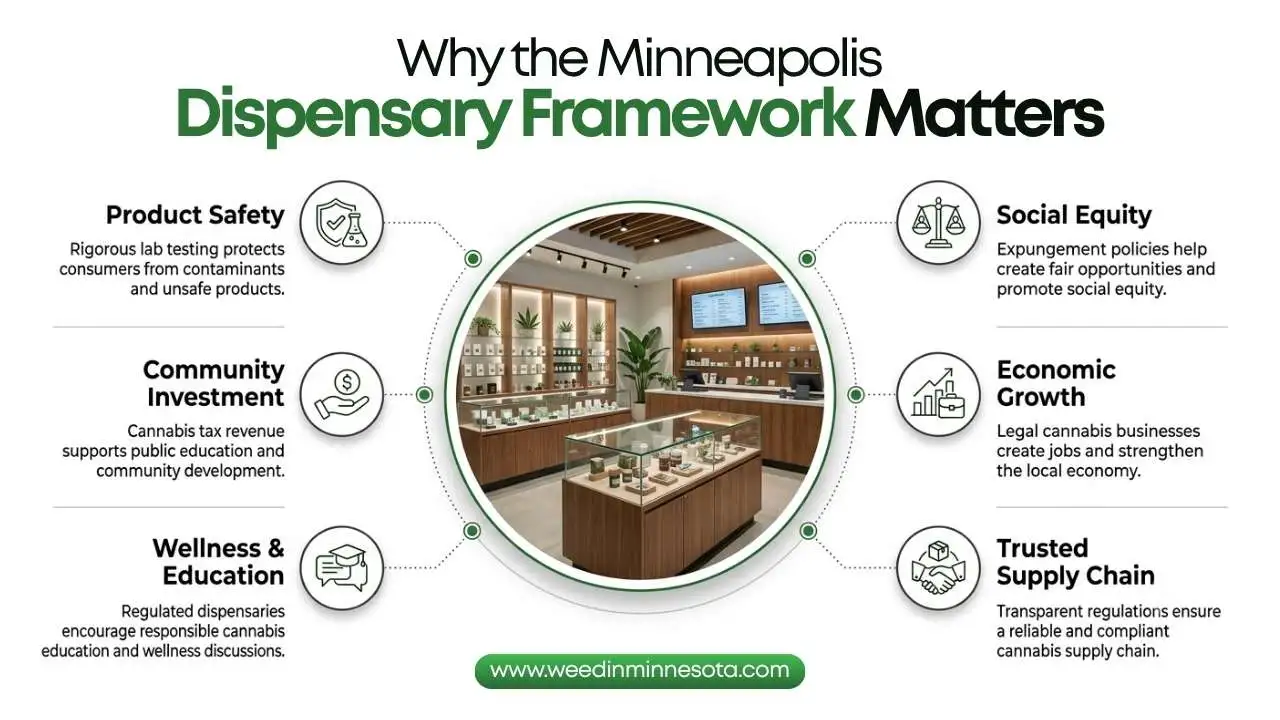
Why the Minnepolis Dispensary Framework Matters
The emergence of a fully regulated retail cannabis sector in the Twin Cities provides multiple socioeconomic benefits to the local population. For instance, legal establishments guarantee product safety through rigorous lab testing, which screens for heavy metals, pesticides, and microbial contaminants. As a result, this level of transparency protects consumers from the health hazards associated with illicit market products.
Furthermore, the local tax structure directs revenue toward community reinvestment and public education funds. In particular, a 15% state cannabis tax, combined with standard sales taxes, generates substantial state revenue while maintaining reasonable market pricing. In addition to this, the presence of a regulated Minnepolis Dispensary also helps normalize conversational, educational approaches to wellness and adult-use consumption.
Additionally, the transition to legal retail helps mitigate historically inequitable enforcement of drug policies. To address this, the state framework includes robust expungement provisions for past minor cannabis convictions, creating paths toward social equity. Ultimately, by establishing a reliable, transparent supply chain, Dispensary Minneapolis operators foster economic growth and create professional opportunities within the agricultural and retail sectors.
Consumer Demographics and Personas
The retail market attracts a highly diverse demographic spanning multiple age groups and literacy levels. To illustrate this, the following table details the primary user personas.
| Persona Name | Demographic Details | Cannabis Literacy | Key Pain Points | Strategic Solution |
| The Cautious Professional | Age 35-45, suburban resident, corporate employee | Beginner level |
Fear of legal non-compliance; confusion regarding product dosage and safety. |
Consequently, clear, lab-tested product labels and structured dosage guides provided by a Minnepolis Dispensary. |
| The Therapeutic Patient |
Age 55-65, managing chronic pain or autoimmune conditions |
Intermediate level |
High cost of therapeutic formulations; limited geographic access to dispensaries. |
Therefore, utilizing the merged Minneapolis Dispensary medical supply chain for lower costs and home delivery. |
| The Recreational Enthusiast | Age 21-30, urban resident, college graduate | Advanced level |
Long queue times at popular shops; inconsistent strain availability. |
As a result, placing online pre-orders for curbside or in-store pickup to bypass wait times. |
| The Traveling Visitor | Age 25-40, out-of-state business traveller | Beginner to Intermediate |
Unfamiliarity with Minnesota transport laws and public consumption limits. |
Accordingly, direct education from a certified Dispensary Minneapolis regarding state possession rules. |
Operational Differences in Dispensary Minneapolis Options
Navigating the regional market requires a clear understanding of the operational models that consumers encounter. To clarify these differences, the following table contrasts the primary retail options available to residents.
| Feature / Retail Type | State-Licensed Retail (OCM) | Tribal-Sovereign Retail | Unlicensed Hemp/CBD Shops |
| Primary Regulatory Body |
Minnesota Office of Cannabis Management |
Tribal Sovereign Nations (e.g., White Earth) |
General State Retail Laws (Unlicensed for Cannabis) |
| Applicable State Cannabis Tax |
15% State Tax + 6.875% Sales Tax |
Excluded (No State Cannabis Tax) |
Standard Sales Tax Only (Low-potency only) |
| Flower & Concentrate Access |
Fully Available within State Limits |
Fully Available within Tribal/State Limits |
Prohibited (Limited to low-potency hemp) |
| Age Requirement |
21+ with Valid Photo ID |
21+ with Valid Photo ID |
Varies, typically 21+ for hemp THC |
| Delivery & Curbside Pickup |
Allowed via licensed operators |
Typically in-store pickup |
Varies by individual retail policy |
Navigating a Minnepolis Dispensary: A Step-by-Step Purchase Guide
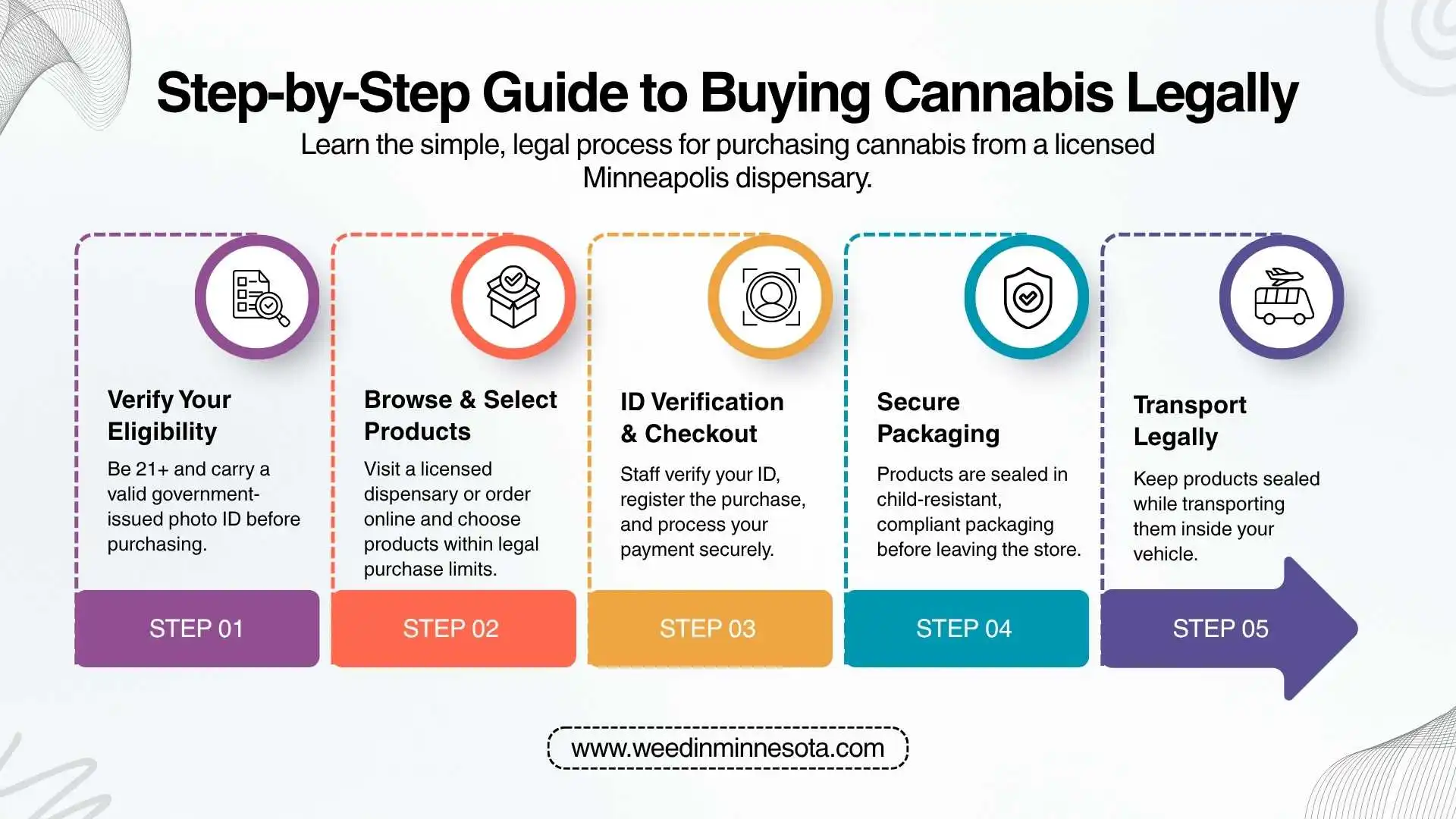
The process of acquiring regulated cannabis products involves several specific steps designed to maintain legal compliance and consumer safety.
To begin with, the consumer must verify eligibility by confirming they are at least 21 years of age and possessing a valid government-issued photo identification, such as a driver’s license or passport. Subsequently, upon entering the physical facility or accessing an online portal like weedinminnesota.com, the individual selects the desired products, ensuring the total amount does not exceed the legal daily purchase limits. Thereafter, the dispensary staff verifies the identification at the point of sale, registers the transaction, and processes the payment using accepted methods, which typically include cash, debit cards, or specialized mobile payment apps due to federal banking restrictions. Finally, the retailer packages the products in child-resistant, compliant exit bags, which the buyer must keep sealed while transporting them inside a motor vehicle.
Legislative Advancements: The 2026 Omnibus Bill and Market Integration
The landscape of Cannabis Minneapolis underwent a major structural realignment following the passage of the 2026 Omnibus Cannabis Bill (SF4401). In fact, signed into law by Governor Tim Walz, this legislation addressed early operational challenges by simplifying licensing structures and stabilizing the local supply chain. Specifically, a key milestone of the bill is the introduction of the cannabis macro business license, effective January 1, 2027.
This new licensing category replaces the older medical combination business framework, allowing operators to cultivate, process, and retail both medical and adult-use products under a unified corporate structure. However, to prevent market monopolization and encourage local craft growers, the bill reduces the maximum allowable plant canopy for macro businesses to 38,000 square feet. Consequently, this downscaling ensures a more diverse, competitive retail environment across the state.
Another critical aspect of the 2026 legislation is the integration of the Minneapolis Dispensary medical and recreational supply chains. Historically, patients faced limited product availability and high costs due to separate production tracks. To resolve this issue, merging these pathways protects patient access to therapeutic formulations and allows standard recreational facilities to serve registered medical patients efficiently.
Additionally, the bill offers a regulatory lifeline to the existing hemp industry. Indeed, facing a strict federal ban on hemp products with specific delta-9 limits, Minnesota now allows licensed hemp operators to hold adult-use cannabis licenses simultaneously. Furthermore, the law also defines “ratio hemp-infused cannabis products,” permitting a balanced blend of up to 10 mg of THC and 100 mg of non-psychoactive cannabinoids (such as CBD or CBN) per serving.
Minnepolis Dispensary Product Comparison and Pricing Analysis
Selecting the appropriate product requires an understanding of consumption methods, onset times, and typical potencies available in the regional market. To help visualize these options, the following table details the key attributes of standard inventory items.
| Product Category | Typical Onset Time | Duration of Effects | Key Benefits | Common Formats & Sample Prices |
|
Cannabis Flower |
1 to 5 Minutes | 2 to 4 Hours |
Rapid onset, full terpene profile, cost-effective |
Whole bud, pre-ground, pre-rolls; Grasslandz 3.5g for $52.00 |
|
Vaporizer Cartridges |
1 to 5 Minutes | 2 to 4 Hours |
Discreet, portable, highly concentrated |
510-thread carts, disposable pens; 1g Disposable for $69.99 |
|
Edibles (THC) |
30 to 90 Minutes | 4 to 8 Hours | Long-lasting effects, precise dosing, smoke-free |
Gummies, chocolates, dissolvable tablets; Camino Gummies (100mg) for $25.00 |
|
THC Beverages |
15 to 45 Minutes | 3 to 5 Hours |
Socially familiar, rapid-onset nanoemulsions |
Seltzers, sodas, large-format multi-serve drinks; Cans starting at $5.00 to $8.00 |
|
Concentrates |
1 to 5 Minutes | 2 to 4 Hours | High potency, immediate effect for experienced users |
Wax, shatter, live resin, RSO gummies; 1g Live Resin starting at $75.00 |
Minneapolis Dispensary medical and Recreational Paradigms
While adult-use cannabis is accessible to any individual over the age of 21, the Minneapolis Dispensary medical system remains highly relevant for specific populations. Specifically, patients diagnosed with state-approved qualifying conditions—such as epilepsy, cancer, or severe chronic pain—can secure a medical certification from a registered healthcare practitioner.
Registered patients benefit from unique financial and operational advantages when visiting a Minnepolis Dispensary. For example, medical purchases are exempt from the standard adult-use excise taxes, leading to significant cost savings over time. In addition, licensed cultivators must prioritize the supply of medically beneficial strains, ensuring consistent access for vulnerable consumers. To demonstrate this, the table below contrasts the operational parameters of medical and recreational purchases within the Twin Cities metropolitan area.
| Parameter | Medical Cannabis Program | Adult-Use Recreational Program |
| Access Eligibility |
Registered Patients & Certified Caregivers |
Anyone Aged 21 or Older with Photo ID |
| Taxation Rate |
Exempt from 15% Cannabis Excise Tax |
Subject to 15% Excise Tax + Local Sales Taxes |
| Public Possession Limit |
Subject to medical prescription limits |
2 Ounces (56.7 grams) of Dried Flower |
| Home Possession Limit | Not strictly capped for medical needs |
2 Pounds (907 grams) of Flower |
| Product Availability |
Dedicated high-potency and specialized forms |
Standardized flower, edibles, and vapes |
Common Consumer Pitfalls in the Minnepolis Dispensary
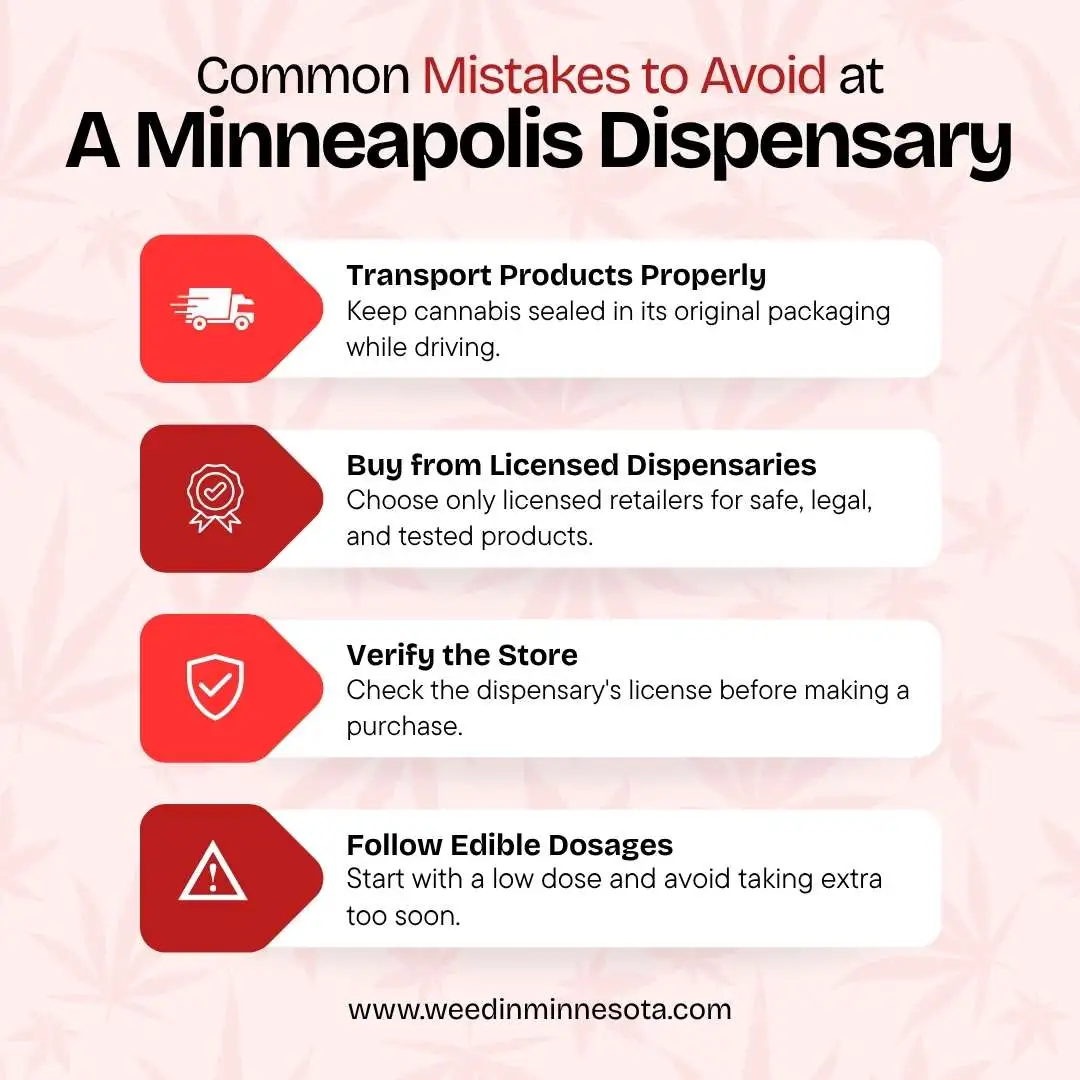
As the retail infrastructure matures, newer consumers often make preventable mistakes regarding product usage, transportation, and legal compliance. Indeed, one frequent error involves the improper transport of cannabis in motor vehicles. Specifically, Minnesota law dictates that all cannabis products must remain in their original, sealed, unopened packaging while inside a vehicle. Consequently, prosecutors have filed over 3,500 vehicle-related possession charges since legalization, emphasizing strict enforcement of open-container laws.
Another common mistake involves purchasing from unlicensed storefronts. In many cases, some retail shops market themselves as dispensaries but are actually unlicensed hemp or CBD shops that cannot legally sell regulated cannabis. Fortunately, consumers can avoid this pitfall by checking official licensing directories or sourcing directly from established, trusted operators such as weedinminnesota.com, which delivers verified, high-quality products across Saint Paul and Minneapolis.
Finally, many novice consumers misunderstand edible dosing. For instance, standard retail edibles are capped at 10 mg of THC per serving, but effects can take up to 90 minutes to manifest. As a result, consuming additional servings before the initial dose takes effect often leads to unpleasant over-intoxication.
Frequently Asked Questions (FAQs)
Q : Is recreational cannabis legal in Minneapolis, Minnesota?
A : Yes, recreational adult-use cannabis became legal in Minnesota on August 1, 2023, under House File 100. Specifically, adults aged 21 or older may legally purchase, possess, and consume cannabis within state-mandated limits.
Q : How much cannabis can an individual legally possess?
A : In public, an adult may possess up to 2 ounces (56.7 grams) of dried cannabis flower, 8 grams of concentrate, or 800 milligrams of edible THC. Conversely, at a private residence, individuals may possess up to 2 pounds of cannabis flower.
Q : Can consumers order cannabis for delivery in Minneapolis?
A : Yes, home delivery is fully legal for licensed retailers in Minnesota. Indeed, platforms like weedinminnesota.com provide convenient, discreet delivery services across Saint Paul, Minneapolis, and the broader Twin Cities area, delivering premium selections safely to consumers’ doorsteps.
Q : What are the rules for home cultivation in Minnesota?
A : Adults aged 21 or older may cultivate up to 8 cannabis plants per residence, with a maximum of 4 mature, flowering plants at any single time. In addition, the cultivation area must be enclosed, locked, and completely hidden from public view.
Q : Are there public consumption lounges in Minneapolis?
A : As of 2026, Minnesota law does not permit licensed cannabis lounges or social consumption spaces. Instead, public consumption remains a petty misdemeanour punishable by a fine of up to $300.
Conclusion and Strategic Market Outlook
The retail landscape in the Twin Cities represents a highly structured, progressive market designed to balance economic opportunity with public safety. As the market evolves, the state continues to refine its regulatory framework through legislative updates like the 2026 Omnibus Bill. As a result, both consumers and medical patients gain access to safer, more diverse, and highly regulated product options. Ultimately, navigating this ecosystem successfully requires compliance with state laws regarding transport, possession, and age verification.
For consumers seeking the highest quality selections without the hassle of navigating physical storefronts, weedinminnesota.com offers an unmatched retail experience. Indeed, as a premier, trusted MN cannabis dispensary boasting over 600+ 5-star Google reviews, the platform delivers premium, lab-tested cannabis products to Saint Paul, Minneapolis, and surrounding areas. In other words, to explore a robust catalogue of premium flower, high-potency concentrates, and precisely dosed edibles, consumers can buy directly from the leading online Cannabis Minneapolis delivery service and secure safe, discreet shipments today.
Frequently Asked Questions
A Minnepolis Dispensary represents a state-authorized or tribal-governed retail venue licensed to sell recreational or medical cannabis products to qualified individuals. Generally speaking, these facilities operate under strict compliance metrics established by the Minnesota Office of Cannabis Management (OCM) or sovereign tribal authorities. Moreover, the storefronts provide a controlled, educational environment where certified specialists, commonly known as budtenders, guide consumers through diverse product lines.
The emergence of a fully regulated retail cannabis sector in the Twin Cities provides multiple socioeconomic benefits to the local population. For instance, legal establishments guarantee product safety through rigorous lab testing, which screens for heavy metals, pesticides, and microbial contaminants. As a result, this level of transparency protects consumers from the health hazards associated with illicit market products.
The retail market attracts a highly diverse demographic spanning multiple age groups and literacy levels. To illustrate this, the following table details the primary user personas. Persona Name Demographic Details Cannabis Literacy Key Pain Points Strategic Solution The Cautious Professional Age 35-45, suburban resident, corporate employee Beginner level Fear of legal non-compliance; confusion regarding product dosage and safety.
Navigating the regional market requires a clear understanding of the operational models that consumers encounter. To clarify these differences, the following table contrasts the primary retail options available to residents. Feature / Retail Type State-Licensed Retail (OCM) Tribal-Sovereign Retail Unlicensed Hemp/CBD Shops Primary Regulatory Body Minnesota Office of Cannabis Management Tribal Sovereign Nations (e.
The process of acquiring regulated cannabis products involves several specific steps designed to maintain legal compliance and consumer safety. To begin with, the consumer must verify eligibility by confirming they are at least 21 years of age and possessing a valid government-issued photo identification, such as a driver's license or passport. Subsequently, upon entering the physical facility or accessing an online portal like weedinminnesota.
Pingback: Top Weed Delivery Commercial Laws & Secure MN Delivery Guide
Pingback: MN THC Dispensary | Buy Trusted Cannabis & Vapes Online
Pingback: Blueberry Strain Guide | Trusted MN Cannabis Dispensary
Pingback: Black Maple Strain Review: Terpenes, Effects & Sourcing MN
Pingback: Cherry Paloma Strain Guide: Sourcing, Terpenes, & Effects
Pingback: SFV OG strain Review: Effects, Benefits, & Purchasing Guide
Pingback: Weed Dispensary Minnesota: Legal Laws & Top Retail Stores
Pingback: Best Dispensary in Minnesota: Complete Guide & Top Stores