Finding the Best Dispensary in Minnesota has become essential for consumers navigating the state’s rapidly evolving legal cannabis landscape. Specifically, the passage of Minnesota House File 100 (HF 100) on May 30, 2023, codified under Minnesota Statutes Chapter 342, established the framework for the state’s commercial adult-use cannabis industry. As a result, Minnesota became the twenty-third state to legalize adult-use cannabis, instituting a market model distinguished by two parallel operational tracks: sovereign Native American tribal enterprises and state-licensed commercial operators governed by the Minnesota Office of Cannabis Management (OCM). Furthermore, the transition from decriminalization to a fully functioning retail marketplace introduces unique economic dynamics, regulatory compliances, and supply-chain structures across the Upper Midwest.
Therefore, evaluating the operational performance of each storefront to determine the Best Dispensary in Minnesota requires an objective examination of statutory possession parameters, product quality assurance standards, geographic distribution patterns, and consumer-facing retail models across both the Twin Cities metropolitan area and Greater Minnesota. Additionally, whether you are seeking a licensed MN dispensary recreational destination or searching for a trusted MN dispensary near me, understanding these regulatory criteria ensures a safe, compliant, and premium shopping experience.
Statutory Framework: Compliance at the Best Dispensary in Minnesota
First, Minnesota cannabis law distinguishes between public and residential possession, commercial retail allowances, and personal home cultivation. In particular, decriminalization, public possession rights, and personal home cultivation allowances took effect on August 1, 2023. Subsequently, centralized administrative oversight transitioned to the OCM, which also assumed direct regulatory responsibility over the preexisting Minnesota Medical Cannabis Program on March 1, 2025, to unify compliance tracking and testing mandates.
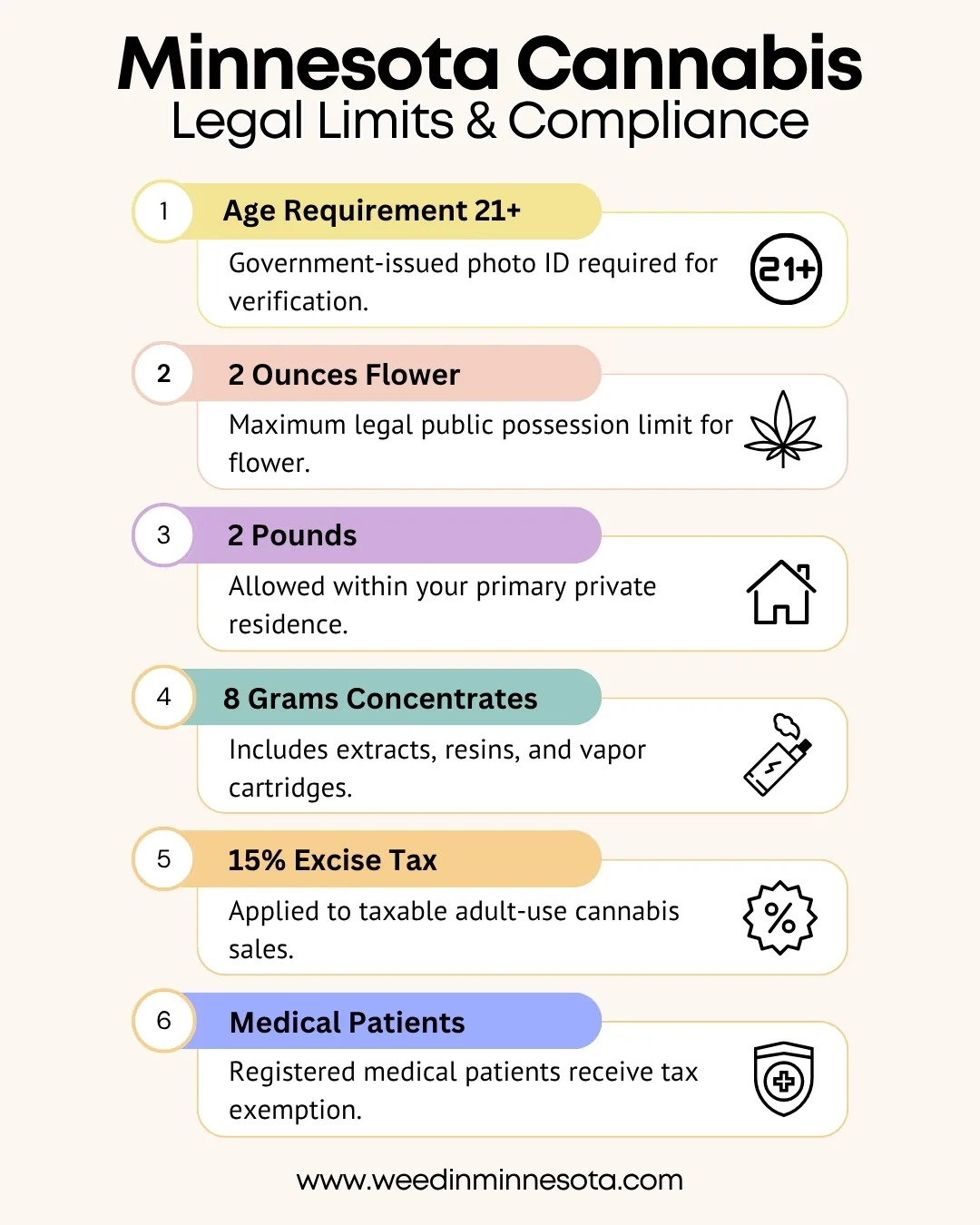
Legal Purchase Limits Under Chapter 342
Consequently, the statutory guidelines established under Minnesota Statutes Chapter 342 define clear possession and operational parameters designed to curb illicit trade while establishing enforceable boundaries for regulated dispensaries and individual consumers.
| Statutory Domain | Legal Threshold (MN Stat. Chapter 342) | Operational and Compliance Notes |
| Minimum Age Requirement | 21 years of age or older |
Mandatory verification via government-issued photo ID prior to showroom entry |
| Public Flower Possession | 2.0 ounces (56.7 grams) |
Applies to transport in motor vehicles and public pedestrian transit |
| Private Home Possession | 2.0 pounds (907.2 grams) |
Strictly confined to an individual’s primary private residence |
| Concentrate Allowance | 8.0 grams total |
Covers solventless extracts, hydrocarbon resins, and vaporization cartridges |
| Infused Edible Cap | 800 milligrams of Delta-9 THC |
Aggregated across commercial adult-use products and lower-potency hemp edibles |
| Domestic Cultivation | Up to 8 plants per residence |
Maximum of 4 mature (flowering) plants; requires an enclosed, locked space |
| Cannabis Gross Receipts Tax | 15% statutory excise tax |
Levied on gross receipts from retail sales of all adult-use cannabis products |
| State General Sales Tax | 6.875% state baseline |
Combined with municipal and county local option sales taxes |
| Medical Registry Exemption | 0% sales and excise tax |
Patients certified through the OCM medical registry receive complete tax exemption |
Public Consumption Restrictions and Impairment Statutes
Moreover, public consumption parameters restrict usage under the Minnesota Clean Indoor Air Act, which prohibits smoking and vaping in public indoor spaces, bars, restaurants, commercial workplaces, and health clinics. For example, municipal parks, including the Minneapolis Park and Recreation Board system, enforce complete prohibitions on cannabis consumption. Similarly, multifamily residential housing developments remain closed to indoor and balcony cannabis smoking or vaping, reserving statutory exemptions exclusively for registered medical patients. In addition, operating a motor vehicle while impaired remains illegal under state driving-while-impaired statutes, although Minnesota law enacted an evidentiary protection on August 1, 2024, that prohibits law enforcement from conducting warrantless vehicle searches based solely on the odor of cannabis.
Dual-Market Paradigm: Tribal Sovereignty and State Licensing for the Best Dispensary in Minnesota
A distinctive structural attribute of Minnesota’s commercial cannabis rollout is the divergence between tribal sovereign commerce and the OCM municipal licensing pathway. Specifically, through state-tribal compacts authorized under HF 100, sovereign Native American nations retained the independent authority to formulate regulatory frameworks, license commercial cultivation, and open retail adult-use dispensaries ahead of the off-reservation commercial rollout. For this reason, many early shoppers searching for the Best Dispensary in Minnesota visited tribal lands.
Sovereign Tribal Retail Success in Minnesota
In practice, sovereign enterprises deployed vertically integrated facilities adhering to tribal regulatory ordinances alongside seed-to-sale tracking systems equivalent to Metrc. As a result, tribal dispensaries emerged as the primary source of regulated adult-use flower, pre-rolls, and extracts throughout the early implementation phases. For instance, prominent sovereign operators include Waabigwan Mashkiki (White Earth Nation), which opened cultivation and multi-store footprints spanning Mahnomen, Moorhead, St. Cloud, East Grand Forks, and Chanhassen; NativeCare (Red Lake Band of Chippewa); Island Peži (Prairie Island Indian Community); Ishkode Dispensary (Bois Forte Band); Anang (Fond du Lac Band); Sweetest Grass (Leech Lake Band of Ojibwe); and Off The Path (Lower Sioux Indian Community).
State Licensing Milestones for an MN Dispensary Recreational Market
Concurrently, the OCM developed rules governing non-tribal commercial license classifications, including cultivators, manufacturers, wholesalers, transporters, microbusinesses, mezzobusinesses, delivery services, and standalone retailers. Furthermore, legislative refinements under SF 4401 expanded the social equity framework, allowing qualified social equity applicants—including service-disabled veterans, small farmers, and individuals from areas disproportionately impacted by historical cannabis enforcement—to access technical support, priority lottery positioning, and an increased outside investment cap of up to 33% across up to four commercial licenses, provided equity applicants retain a minimum 65% operational and governance control. Meanwhile, local municipalities maintain statutory rights to perform operational registrations and enforce density restrictions capped at a baseline of one dispensary per 12,500 residents.
Metropolitan Retail Distribution: Finding the Best Dispensary in Minnesota
Commercial cannabis retail access is primarily concentrated within the Minneapolis-Saint Paul-Bloomington metropolitan area, before extending into regional hubs such as Duluth, Rochester, and St. Cloud. In fact, shoppers looking for the Best Dispensary in Minnesota or an MN dispensary near me will find that retail operators in these markets balance walk-in traffic, online order staging, dedicated curbside pickup lanes, and regulated home delivery networks.
| Operating Dispensary Network | Core Municipal Footprint | Licensing & Corporate Model | Primary Product and Service Specializations |
| Green Goods |
Minneapolis (Downtown), Bloomington, Blaine, Woodbury, Hermantown, Rochester |
Medical & Adult-Use Dual Licensee |
Hydrocarbon extracts, solventless rosin, broad-spectrum edibles, pre-rolls, online ordering |
| RISE Dispensaries |
Saint Paul (Ford Pkwy), Brooklyn Park, New Hope, Eagan |
Medical & Adult-Use Dual Licensee |
Dogwalker mini-joints, precision vaporization cartridges, high-terpene indoor flower, delivery |
| Waabigwan Mashkiki |
Chanhassen, St. Cloud, Moorhead, Mahnomen |
Sovereign Tribal Enterprise (White Earth) |
Small-batch single-source flower, Native Cuts cultivars, live resin infused joints, direct retail |
| Hopkins Dispensary |
Hopkins (West Metro) |
State-Licensed Adult-Use Retailer |
Curated multi-strain flight packs, high-potency pre-rolls, solventless concentrates, educational consults |
| Levitated Dispensaries | Boutique Urban Adult-Use Retailer |
Infused joints, single-gram and multi-pack pre-rolls, craft extracts, solventless rosin vapes |
|
| Frostbite Dispensary |
Roseville (Ramsey County) |
Metro-Area Adult-Use Dispensary |
Minnesota craft cultivators, artisan edibles, strain-specific terpene-rich pre-rolls, pickup |
| Sweetleaves |
Minneapolis (North Loop) |
Urban Specialty Retailer |
Curated boutique strains, exotic genetics, premium flower jars, rosin carts, infused singles |
Urban vs. Suburban Retail Formats in the Twin Cities
On one hand, urban retail locations in Minneapolis and Saint Paul cater predominantly to high-density foot traffic, transit access, and neighborhood walkability, requiring compact floor designs and fast point-of-sale verification systems.
On the other hand, suburban dispensaries situated in Bloomington, Roseville, Hopkins, and Brooklyn Park emphasize automobile accessibility, parking logistics, dedicated curbside pickup spaces, and regional delivery routing to meet consumer convenience expectations. In addition, Saint Paul locations along key corridors, such as Ford Parkway, effectively bridge these two models by offering dedicated storefront retail alongside vehicle-dispatched home delivery across Ramsey and Dakota counties. Therefore, selecting the Best Dispensary in Minnesota or identifying the top Best dispensary in MN often depends on whether a consumer prioritizes walk-in speed or dedicated drive-up convenience.
Product Offerings at the Best Dispensary in Minnesota
The inventory architecture of any top-tier retailer competing as the Best Dispensary in Minnesota spans raw biomass, manufactured extracts, and precision-dosed infused consumables. Furthermore, products are categorized across distinct operational lines to align with statutory tracking and consumer preferences.
Essential Cannabis Product Classifications
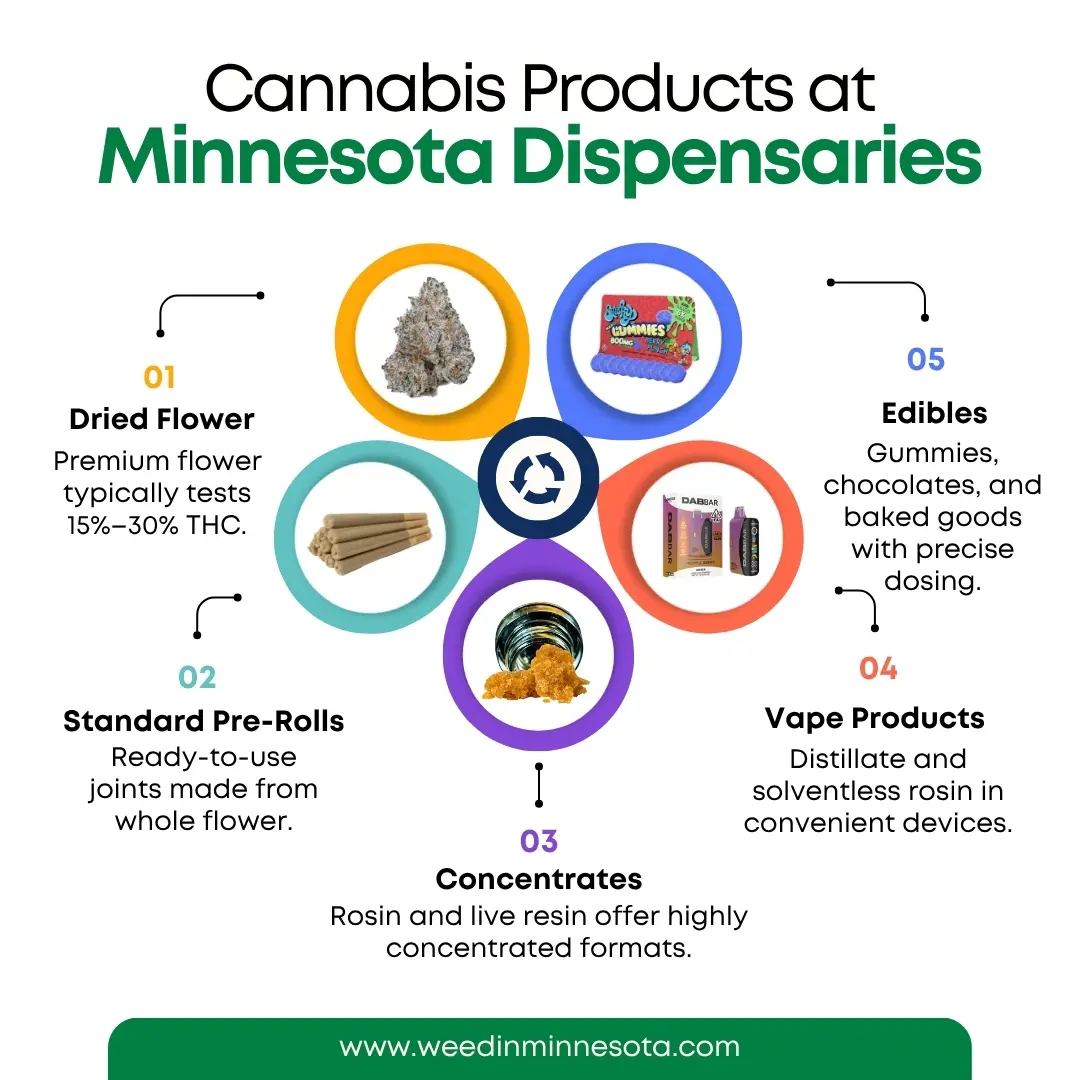
- Loose Dried Flower: Nitrogen-sealed jars and barrier pouches (3.5g to 14g) testing between 15% and 30% THC. In practice, flower purchases deduct directly from the 2.0-ounce public possession allowance.
- Standard Pre-Rolls: Ready-to-smoke single joints (0.75g to 1.0g) and convenient multi-packs formulated from ground whole flower. Consequently, their net weight counts entirely toward the individual’s 2.0-ounce public limit.
- Infused Pre-Rolls: Enhanced pre-rolls combining cured flower with live resin, distillate, or terpene-rich kief reaching 30% to 45%+ THC. Thus, their weight is apportioned across both flower and concentrate statutory limits.
- Inhalation Concentrates: Solventless hash rosin and hydrocarbon live resins testing between 65% and 85%+ total cannabinoids. Importantly, concentrates remain subject to the state’s strict 8.0-gram public cap.
- Vaporization Hardware: High-grade 510-thread cartridges and all-in-one pods containing pure distillate or solventless rosin. Hence, these units deduct directly from your statutory 8.0-gram concentrate allowance.
- Adult-Use Edibles: Precisely dosed gummies, chocolates, and baked goods capped at 10mg THC per serving and 200mg per package. Accordingly, these products deduct from the 800mg edible limit.
- Hemp-Derived Consumables: Widely available seltzers and micro-dose gummies capped at 5mg THC per serving. As a result, they offer an accessible entry point while counting toward aggregate consumption caps.
Pre-Roll Popularity and Formulations
Specifically, standard and infused pre-rolled products represent an expanding share of retail transactions due to their convenience and elimination of grinding or rolling preparation. In addition, pre-rolls offer clear dosing increments, standardizing consumption for beginner consumers while supplying portable formats for experienced users.
Concurrently, Minnesota’s bifurcated edible landscape distinguishes between low-dose hemp-derived edibles (capped at 5mg per serving) widely distributed in non-dispensary retail settings, and licensed dispensary edibles formulated up to 10mg per serving with specialized cannabinoid-terpene matrices. Consequently, visiting the Best Dispensary in Minnesota gives adult consumers access to full-potency formulations that standard retail grocers cannot carry.
Consumer Profiles and Operational Dynamics at an MN Dispensary Recreational Hub
Understanding Consumer Archetypes
Dispensary operations cater to four distinct consumer archetypes, each presenting unique service and fulfillment demands:
- The Entry-Level Adult-Use Consumer: Individuals seeking low-dose relaxation, sleep support, or mild euphoria. For example, this cohort requires structured consultative interactions, clear warnings regarding edible onset latencies (which range from 45 to 120 minutes due to hepatic 11-hydroxy-THC conversion), and non-combustible formats such as micro-dose gummies and mini pre-rolls.
- The High-Involvement Connoisseur: Experienced buyers focused on terpene profiles, harvest cure dates, cultivation methodologies, and single-source solventless extraction techniques. Therefore, this group prioritizes small-batch craft cultivars, verifiable genetic lineages, and packaging integrity over broad commercial branding.
- The Medical Registry Patient: Patients managing certified physiological or neurological conditions who require predictable cannabinoid ratios, reliable stock of therapeutic profiles, and tax-exempt transactions. Furthermore, these patients require consistent access to high-potency medicine without commercial market supply interruptions.
- The Convenience-Driven Professional: Metro-area consumers prioritizing transaction velocity, consistent curbside fulfillment, secure mobile ordering, and transparent parking or delivery infrastructure. In contrast to leisure shoppers, this cohort values speed above all else.
Banking Constraints and Interstate Transport Realities
Meanwhile, operational challenges remain prevalent even at the Best Dispensary in Minnesota. Specifically, the continued federal classification of cannabis as a Schedule I controlled substance limits direct access to mainstream interstate financial clearinghouses and traditional credit card processing. Consequently, Minnesota dispensaries operate on cash-only frameworks or deploy point-of-banking debit solutions (cashless ATMs) that levy network surcharges on consumers, requiring retail facilities to maintain physical automated teller machines (ATMs) on site.
In addition, interstate border enforcement presents a critical operational friction point. Because Minnesota shares borders with four states—North Dakota, South Dakota, Iowa, and Wisconsin—none of which maintain fully integrated, commercial adult-use retail systems, legal confusion often arises. Although out-of-state visitors aged twenty-one and older can legally enter any MN dispensary near me and make purchases up to daily statutory allowances, transporting cannabis across state boundaries remains a federal crime and exposes individuals to severe legal sanctions in bordering jurisdictions. For this reason, the Best Dispensary in Minnesota actively posts point-of-sale warnings to mitigate accidental cross-border transport by traveling consumers.
Taxation Architecture: Retail Pricing at the Best Dispensary in Minnesota
First, the retail pricing of adult-use cannabis in Minnesota is shaped by compounding fiscal levies that differentiate the recreational market from the medical program. Specifically, adult-use cannabis transactions carry a compounding tax structure consisting of several distinct layers:
- The 15% state Cannabis Gross Receipts Tax, which applies directly to the retail sale price of all taxable cannabis flower, concentrates, and infused products.
- The 6.875% Minnesota General State Sales Tax.
- Applicable municipal, transit, and county sales taxes, which commonly range between 0.5% and 2.0% in Minneapolis, Saint Paul, and surrounding Hennepin and Ramsey County jurisdictions.
Comparative Tax Impact on Adult-Use vs. Medical Buyers
As a result, cumulative retail taxes on recreational cannabis across the Twin Cities core range from approximately 22.375% to 24%. Furthermore, under Minnesota Statute Chapter 342, 80% of cannabis excise revenues are directed into the state’s general fund, while 20% is apportioned to local government aid programs to fund municipal administration, public health initiatives, and regulatory compliance.
By contrast, products sold to registered patients within the Minnesota Medical Cannabis Program are exempt from the 15% excise tax, the state sales tax, and local surcharges. Because of this statutory relief, the 0% tax rate offers sustained cost savings for individuals with chronic qualifying health conditions who maintain active registry standing.
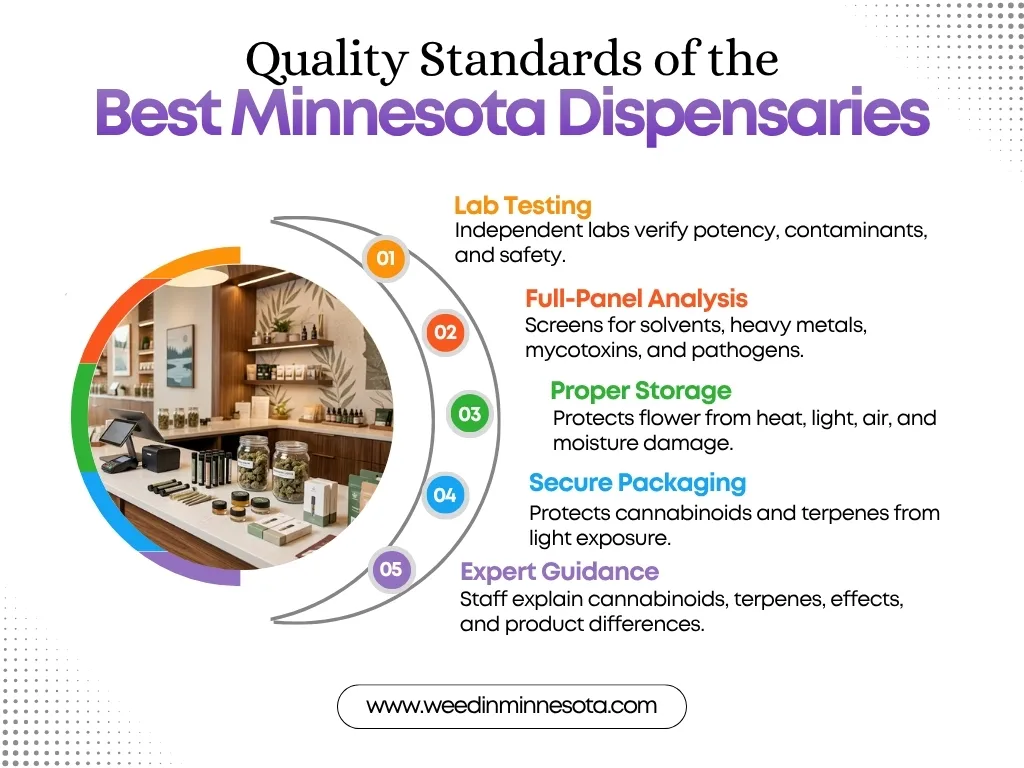
Quality Standards: Identifying the Best Dispensary in Minnesota
Professional dispensary operations maintain distinct technical benchmarks across testing verification, storage conditioning, and consultative pharmacology:
- Analytical Testing Protocols and COA Transparency: Specifically, authoritative dispensaries provide accessible, batch-specific Certificates of Analysis (COAs) produced by independent testing laboratories accredited by the OCM. In addition, full-panel laboratory analyses confirm target cannabinoid potency and screen for residual chemical solvents, foreign matter, heavy metals (lead, arsenic, cadmium, mercury), mycotoxins, and biological pathogens such as Aspergillus and Salmonella.
- Atmospheric Preservation and Storage Infrastructure: Furthermore, prolonged exposure to ambient air, elevated temperatures, and ultraviolet light degrades active Delta-9 THC into cannabinol (CBN) and evaporates volatile monoterpenes like myrcene, beta-pinene, and limonene. Therefore, the Best Dispensary in Minnesota stores raw flower in opaque glass containers or multi-layer barrier mylar packaging under controlled relative humidity conditions (58% to 62%) to prevent desiccation, microbial growth, and aromatic degradation.
- Consultative Competency and Pharmacological Guidance: Moreover, high-performing dispensaries train staff to guide consumers beyond total THC percentage metrics. As a result, consultative budtenders evaluate the entourage effect, educating consumers on how secondary cannabinoids (CBD, CBG, CBN) interact synergistically with specific terpene classes to modulate therapeutic and psychoactive outcomes.
Frequently Asked Questions (FAQs)
Q : Does Minnesota have recreational dispensaries open yet?
A : Yes, adult-use cannabis dispensaries are officially open in Minnesota. Consumers can purchase legal flower and edibles through sovereign tribal dispensaries and state-licensed retail locations overseen by the Office of Cannabis Management.
Q : Can you buy pre-rolls in Minnesota?
A : Yes, licensed retailers and tribal dispensaries sell pre-rolled cannabis joints across Minnesota. Adults aged 21 and older can buy single joints, multi-packs, and potent concentrate-infused pre-rolls under the two-ounce flower limit.
Q : Can out-of-state residents purchase cannabis at Minnesota dispensaries?
A : Yes, adults aged 21 and older from any state can legally purchase cannabis by showing a valid government photo ID. However, transporting purchased cannabis across state lines remains illegal under federal law.
Q : What forms of payment do Minnesota dispensaries accept?
A : Most Minnesota dispensaries operate on a cash-only or debit card basis using cashless ATMs due to federal banking rules. Credit cards are not accepted, but on-site ATMs are widely available.
Industry Outlook: The Future of the Best Dispensary in Minnesota
Ultimately, the Minnesota cannabis market is moving toward structural equilibrium as additional OCM-licensed cultivators, manufacturers, and retailers reach full operational capacity. In particular, sovereign tribal nations demonstrated the viability of compact-based regulatory frameworks, providing early supply stabilization that shaped consumer expectations across the Upper Midwest.
As municipal retail density expands in suburban and rural jurisdictions, the market will increasingly reward operators that maintain strict cold-chain and humidity-controlled storage, transparent laboratory verification, and compliant Metrc inventory protocols. For this reason, navigating this evolving market requires consumers and commercial participants to evaluate dispensaries based on analytical rigor, statutory adherence under Minnesota Statutes Chapter 342, and consultative consumer education. Consequently, every buyer can confidently choose the Best Dispensary in Minnesota for their wellness and lifestyle goals.
Frequently Asked Questions
First, Minnesota cannabis law distinguishes between public and residential possession, commercial retail allowances, and personal home cultivation. In particular, decriminalization, public possession rights, and personal home cultivation allowances took effect on August 1, 2023. Subsequently, centralized administrative oversight transitioned to the OCM, which also assumed direct regulatory responsibility over the preexisting Minnesota Medical Cannabis Program on March 1, 2025, to unify compliance tracking and testing mandates.
Consequently, the statutory guidelines established under Minnesota Statutes Chapter 342 define clear possession and operational parameters designed to curb illicit trade while establishing enforceable boundaries for regulated dispensaries and individual consumers. Statutory Domain Legal Threshold (MN Stat. Chapter 342) Operational and Compliance Notes Minimum Age Requirement 21 years of age or older Mandatory verification via government-issued photo ID prior to showroom entry Public Flower Possession 2.
Moreover, public consumption parameters restrict usage under the Minnesota Clean Indoor Air Act, which prohibits smoking and vaping in public indoor spaces, bars, restaurants, commercial workplaces, and health clinics. For example, municipal parks, including the Minneapolis Park and Recreation Board system, enforce complete prohibitions on cannabis consumption. Similarly, multifamily residential housing developments remain closed to indoor and balcony cannabis smoking or vaping, reserving statutory exemptions exclusively for registered medical patients.
A distinctive structural attribute of Minnesota's commercial cannabis rollout is the divergence between tribal sovereign commerce and the OCM municipal licensing pathway. Specifically, through state-tribal compacts authorized under HF 100, sovereign Native American nations retained the independent authority to formulate regulatory frameworks, license commercial cultivation, and open retail adult-use dispensaries ahead of the off-reservation commercial rollout. For this reason, many early shoppers searching for the Best Dispensary in Minnesota visited tribal lands.
In practice, sovereign enterprises deployed vertically integrated facilities adhering to tribal regulatory ordinances alongside seed-to-sale tracking systems equivalent to Metrc. As a result, tribal dispensaries emerged as the primary source of regulated adult-use flower, pre-rolls, and extracts throughout the early implementation phases. For instance, prominent sovereign operators include Waabigwan Mashkiki (White Earth Nation), which opened cultivation and multi-store footprints spanning Mahnomen, Moorhead, St.