Did you know that Minnesota became the 23rd state in the United States to legalize adult-use cannabis, establishing a unique craft-focused and decentralized marketplace? The formal legalization of Minnesota Marijuana has fundamentally transformed the commercial and social landscape of the Upper Midwest. Navigating the expanding system of marijuana minnesota can present challenges for both beginner consumers and experienced buyers. Under the systematic oversight of the Office of Cannabis Management, the regulations governing marijuana in minnesota focus on guaranteeing product safety, establishing market equity, and preventing illicit sales. This comprehensive report analyzes the current statutory parameters, purchasing regulations, and geographic retail structures of Minnesota Marijuana, enabling consumers to make highly informed decisions.
What is Minnesota Marijuana?
The term Minnesota Marijuana refers to the legal, regulatory, and commercial framework governing the cultivation, processing, sale, and consumption of cannabis products containing tetrahydrocannabinol (THC) within the state. Codified under Minnesota Statute Chapter 342 (the Cannabis Regulatory Act), the state permits individuals aged 21 and older to legally purchase, possess, and cultivate cannabis for recreational and medicinal purposes.
The regulatory system categorizes Minnesota Marijuana into distinct product groups:
- Cannabis Flower: Raw, dried flower buds harvested from the female Cannabis sativa plant.
- Concentrates: High-potency extracts, including oils, waxes, distillates, and shatter.
- Edibles and Consumables: Infused food products, lozenges, and ratio hemp-infused cannabis products.
- Lower-Potency Hemp Edibles: Lower-dose gummies and hemp-derived THC seltzers, which have transitioned fully under the licensing authority of the Office of Cannabis Management.
Why It Matters: Public Safety, Economics, and Quality Control
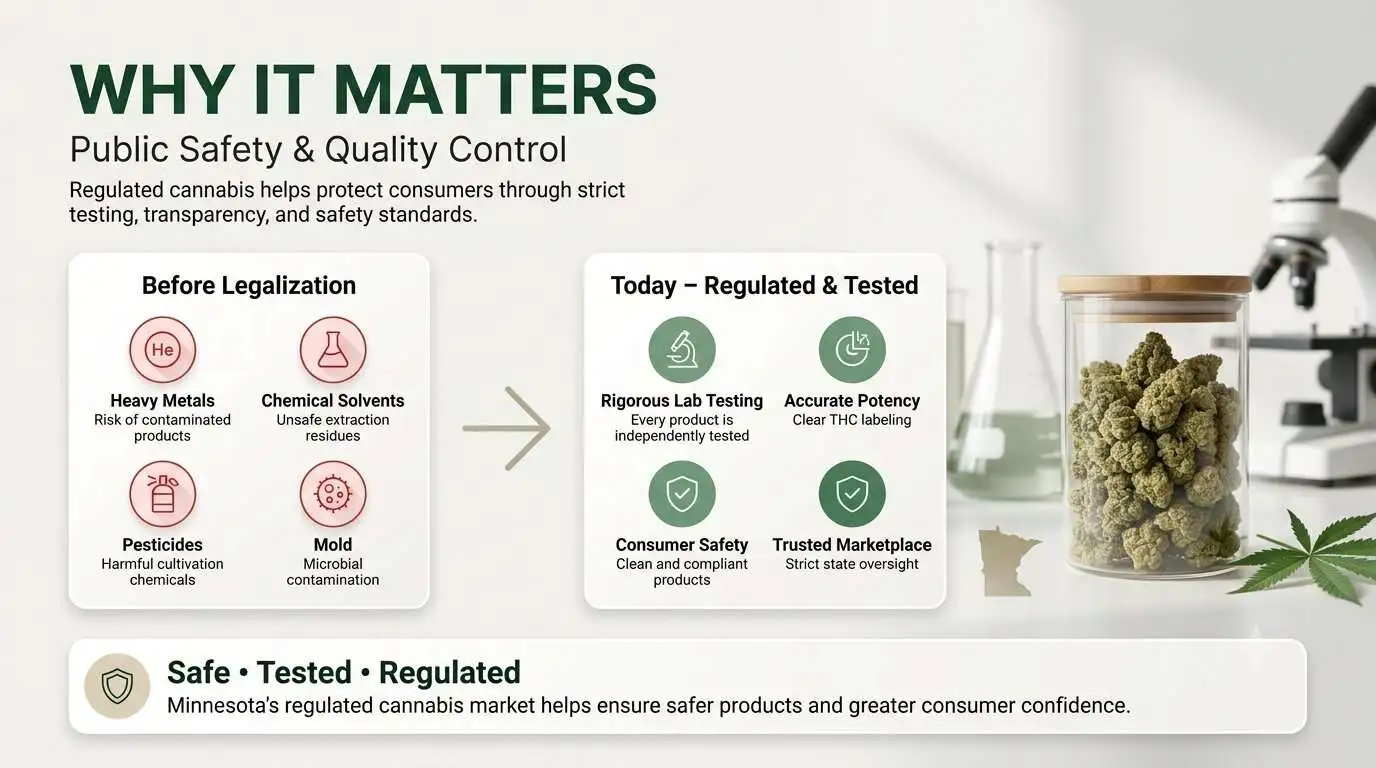
The transition to a regulated market for Minnesota Marijuana addresses critical health and safety risks historically associated with unregulated sales. Prior to legalization, purchasers of marijuana minnesota faced exposure to products contaminated with heavy metals, residual chemical solvents, pesticides, and mold. Today, the Office of Cannabis Management mandates that all legal Minnesota Marijuana undergo rigorous testing at licensed, independent laboratories before entering retail shelves. This systematic vetting guarantees accurate potency labeling and consumer safety.
From an economic perspective, the commercialization of marijuana in minnesota generates vital public funding. The state levies a flat 15% cannabis retail tax on the gross receipts of all taxable adult-use cannabis products, which combines with the standard 6.875% state sales tax and municipal taxes.
The following table outlines the distribution of tax revenues and economic impacts:
| Financial Element | Rate / Allocation Percentage | Public Purpose & Regional Impact |
| State Cannabis Tax | 15% of Gross Receipts |
Applied to general retail sales of adult-use products. |
| State General Fund | 80% of Collected Cannabis Tax |
Funds state infrastructure, public health, and education. |
| Local Government Aid | 20% of Collected Cannabis Tax |
Distributed directly to cities and counties to fund municipal services. |
| Medical Cannabis Tax | 0% (Tax-Exempt) |
Direct tax savings for registered medical program patients. |
Understanding Minnesota Marijuana Limits and Possession Frameworks
To maintain community safety and prevent illicit trafficking, the state enforces strict parameters regarding the volume of cannabis an individual may carry, store, or cultivate. These statutory thresholds, collectively referred to as Minnesota marijuana limits, apply uniformly to all residents and out-of-state visitors.
The table below details the legally permitted possession, purchase, and cultivation parameters:
| Product Category | Public Purchase & Possession Limit | Private Residence Storage Limit |
| Cannabis Flower |
Up to 2 ounces (56.7 grams) |
Up to 2 pounds (907 grams) |
| Cannabis Concentrates |
Up to 8 grams |
Up to 8 grams |
| THC Edibles |
Up to 800 milligrams total THC |
Up to 800 milligrams total THC |
| Home Cultivation | N/A (Public transport of live plants is restricted) |
Up to 8 plants total (Maximum of 4 flowering) |
The established Minnesota marijuana limits dictate that public possession must exactly mirror the single-day retail purchase cap. Consequently, an individual cannot legally buy or carry more than 2 ounces of flower, 8 grams of concentrate, or 800 milligrams of edible THC in public. Purchasing quantities beyond these statutory limits in a single calendar day—even by visiting multiple retail locations—violates minnesota marijuanas laws and triggers civil penalties. Furthermore, point-of-sale systems track transactions via seed-to-sale compliance software to prevent limit violations.
Understanding Minnesota Marijuana Laws
The question of whether adult-use cannabis is marijuana legal in minnesota is answered with a clear yes, subject to specific operational rules. While personal possession and home-grow options became legal on August 1, 2023, the full state-regulated commercial retail rollout expanded extensively into 2026.
To operate within the boundaries of minnesota marijuanas laws, consumers must understand several core restrictions:
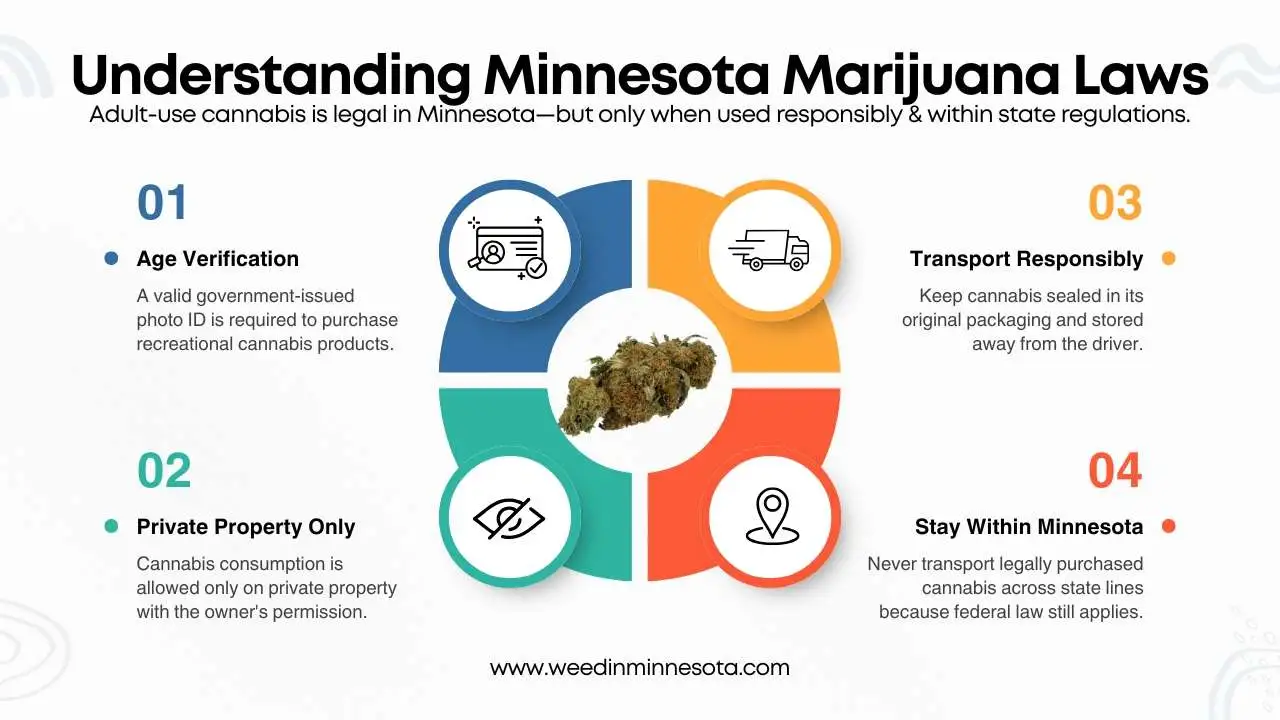
- Age Verification: Purchases require a valid, government-issued photo identification proving the buyer is 21 years of age or older.
- Consumption Spaces: Consumption remains restricted to private residences or private property where the owner permits its use. Smoking or vaping Minnesota Marijuana remains strictly prohibited in multi-family housing units, public parks, transit vehicles, school grounds, and federal property.
- Vehicular Transport: It is illegal to drive under the influence of cannabis. Additionally, open container laws apply; cannabis must be stored in its original, sealed packaging, in the vehicle’s trunk, or in an area inaccessible to the driver and passengers.
- Interstate Transport: Because cannabis remains a Schedule I or Schedule III controlled substance federally, crossing state lines into North Dakota, South Dakota, Iowa, or Wisconsin with legally purchased Minnesota Marijuana constitutes a federal crime.
Legal Comparison: Medical versus Recreational and State versus Tribal Markets
The legal landscape of Minnesota Marijuana operates through distinct channels. Understanding these differences helps buyers identify the most efficient purchase methods.
The following table compares the operational structures of the various market channels:
| Parameter | Medical Cannabis Program | State-Licensed Retail | Sovereign Tribal Retail |
| Tax Rate |
0% (Completely Tax-Exempt) |
15% excise + state/local sales tax |
Tax-free or structured tribal levy |
| Age Limit | 18+ (With certified medical condition) |
21+ only |
21+ only |
| Purchase Limit |
Up to a 30-day supply |
Subject to standard Minnesota marijuana limits [cite: 7] |
Governed by tribal-state compacts |
| Regulatory Authority |
Office of Cannabis Management |
Office of Cannabis Management |
Sovereign Tribal Regulatory Agencies |
| Tracking System | Medical Patient Database |
METRC Seed-to-Sale Software |
Sovereign tracking systems |
Consumer Personas and Common Pain Points in the Market
To understand the practical application of marijuana in minnesota, industry analysts categorize consumers into distinct archetypes.
The Medical Patient Seekers
Individuals in this category navigate chronic conditions and seek consistent therapeutic relief. Their primary pain points include high prices, limited regional product availability, and the complex, multi-step process required to obtain a medical certification.
The Beginner Adult-Use Buyers
These consumers possess limited cannabis literacy and often feel intimidated walking into a physical minnesota marijuana dispensary. Their primary pain points consist of fear of overconsumption, confusion regarding standard dosages, and unfamiliarity with the scientific distinction between Indica, Sativa, and Hybrid options.
The Craft Cannabis Enthusiasts
These buyers seek premium, locally grown, terpene-rich flower cultivars. They reject corporate, mass-produced products and demand absolute transparency regarding harvest dates, curing methods, and minor cannabinoid ratios.
The Regional Travelers
Out-of-state visitors often travel to major hubs like Duluth or Minneapolis. Their primary pain points stem from confusion surrounding transport regulations, the strict ban on crossing state borders, and a lack of clear information regarding where they can legally consume their purchases.
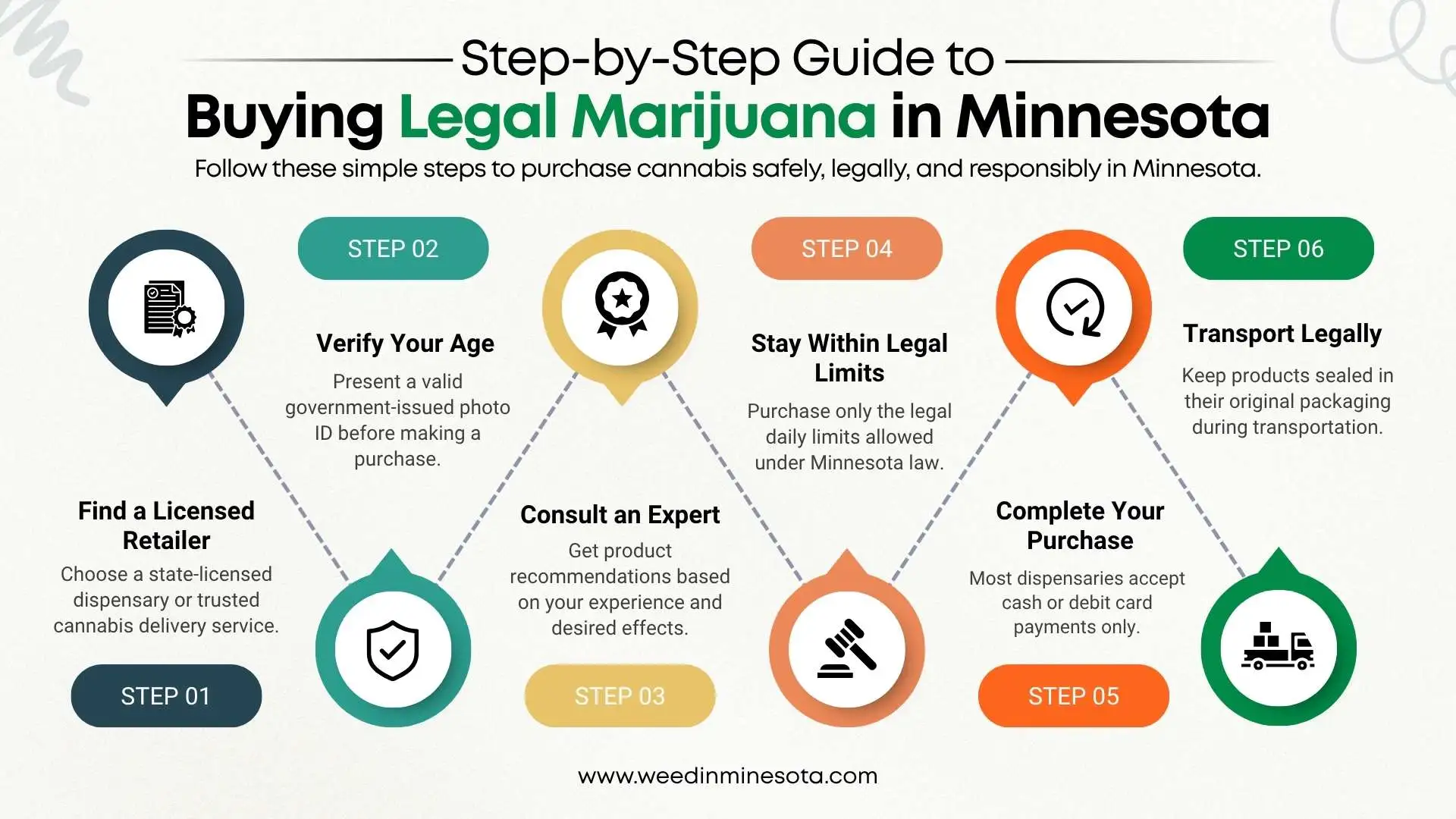
Step-by-Step Guide to Buying Legal Marijuana In Minnesota
For those planning to purchase Minnesota Marijuana, the transaction process follows a highly secure, structured pathway:
- Locate a Licensed Retailer: Consumers must identify a certified retail outlet or a trusted, premium delivery service like weedinminnesota.com, which delivers across Saint Paul, Minnepolis, and the broader Minnesota area.
- Verify Age and Identity: Upon entering the dispensary or receiving a delivery, the buyer must present a valid government-issued photo ID.
- Consult with a Specialist: Beginner buyers can consult with experienced staff to select specific strains, concentrates, or edibles that align with their tolerance levels.
- Confirm Daily Limits: The retail point-of-sale system automatically verifies that the transaction complies with the legal Minnesota marijuana limits (2 oz flower, 8 g concentrate, or 800 mg edibles).
- Complete the Secure Transaction: Because of federal banking restrictions, dispensaries operate primarily via cash or debit cards.
- Store and Transport Legally: Keep all purchased products sealed in their child-resistant, opaque packaging during transport.
Regional Marijuana Dispensary Access in Minnesota
The commercial distribution of Minnesota Marijuana relies heavily on local municipal zoning. While the state blocks local cities from issuing outright bans, municipalities maintain authority to establish buffer zones near schools and limit total retailer density.
The commercial dynamics of major regional hubs show distinct variations:
- Saint Paul: Home to a highly competitive market, Saint Paul emphasizes convenient, customer-focused delivery options. Platforms like weedinminnesota.com lead the sector by offering rapid delivery and curbside pickup options.
- Minnepolis: This major urban center boasts a dense concentration of craft dispensaries and boutique microbusinesses, catering to diverse consumer preferences.
- Bloomington: As a key hospitality hub anchored by the Mall of America, Bloomington dispensaries cater to a high volume of national and international travelers.
- Duluth: Serving as northeastern Minnesota’s primary retail hub, Duluth provides essential access for local residents, North Shore tourists, and Wisconsin visitors.
- Rochester: This southern market focuses heavily on balancing medical access for Mayo Clinic visitors with recreational adult-use sales.
Market Growth and State Licensing Statistics
The Office of Cannabis Management monitors the scale of the market. The rapid expansion of cultivators, manufacturers, and retailers highlights the immense scale of the local cannabis economy.
The table below provides a detailed breakdown of licensing data as of June 2026:
| License Type | Total Applications Submitted | Preliminarily Approved | Active Licenses Issued |
| Retailer (Dispensary) |
854 |
84 |
12 |
| Microbusiness |
1,854 |
1,046 |
198 |
| Mezzobusiness |
273 |
57 |
11 |
| Cultivator |
96 |
32 |
7 |
| Manufacturer |
83 |
16 |
2 |
| LPHE Retailer |
2,320 |
N/A (Uncapped) |
1,790 |
Common Mistakes Consumers Must Avoid
To ensure a seamless experience within the state’s legal framework, buyers of Minnesota Marijuana should actively avoid several common errors:
- Exceeding Daily Thresholds: Attempting to purchase from multiple storefronts on the same day to bypass the 2-ounce public possession limit constitutes a statutory violation tracked by compliance systems.
- Interstate Transport Errors: Transporting legal cannabis across state lines into neighboring states remains a federal offense and can result in severe prosecution.
- Unlawful Public Consumption: Consuming cannabis in public parks, on sidewalks, or near apartment complexes violates the Minnesota Clean Indoor Air Act.
- Improper Storage in Vehicles: Storing open cannabis containers in the glovebox or passenger cabin violates state open-container vehicle laws.
- Purchasing from Unlicensed Sources: Buying from unauthorized gray-market sellers bypasses critical laboratory safety and heavy-metal testing protocols.
Frequently Asked Questions (FAQs)
Q : Can you buy recreational marijuana in Minnesota now?
A : Yes, adults aged 21 and older can legally buy recreational cannabis in the state. Commercial adult-use sales launched systematically through both sovereign tribal dispensaries and state-licensed retail locations.
Q : Is marijuana legalized in Minnesota?
A : Yes, recreational adult-use cannabis is fully legal under state law. The state legalized personal possession, home cultivation, and retail sales under Minnesota Statute Chapter 342.
Q : Do you need a medical card for a dispensary in Minnesota?
A : No, individuals do not need a medical card to shop at a Minnesota recreational dispensary. Anyone aged 21 or older with a valid, government-issued photo ID can legally purchase adult-use cannabis products.
Q : Can you have marijuana in your car in MN?
A : Yes, but the law mandates strict transportation procedures. Cannabis must be kept completely sealed in its original packaging and stored in the trunk or a cargo area out of reach of the driver.
Q : Can you buy pre-rolls in Minnesota?
A : Yes, pre-rolled joints and blunts are widely available for purchase at licensed retail dispensaries and through delivery services.
Conclusion
The legal framework governing Minnesota Marijuana successfully balances safe consumer access with robust public health and safety protocols. By understanding the strict Minnesota marijuana limits and staying informed on local minnesota marijuanas laws, consumers can enjoy a secure, premium experience. For buyers seeking the highest standard of convenience, reliability, and product quality, weedinminnesota.com stands as the premier “Trusted MN Cannabis Dispensary”. Providing an elite inventory of certified cannabis products alongside flexible curbside pickup and fast delivery across Saint Paul, Minnepolis, and the broader Minnesota metro, weedinminnesota.com simplifies legal cannabis shopping. Explore the digital menu today to experience the absolute best in local craft cannabis.
Frequently Asked Questions
The term Minnesota Marijuana refers to the legal, regulatory, and commercial framework governing the cultivation, processing, sale, and consumption of cannabis products containing tetrahydrocannabinol (THC) within the state. Codified under Minnesota Statute Chapter 342 (the Cannabis Regulatory Act), the state permits individuals aged 21 and older to legally purchase, possess, and cultivate cannabis for recreational and medicinal purposes. The regulatory system categorizes Minnesota Marijuana into distinct product groups: Cannabis Flower: Raw, dried flower buds harvested from the female Cannabis sativa plant.
The transition to a regulated market for Minnesota Marijuana addresses critical health and safety risks historically associated with unregulated sales. Prior to legalization, purchasers of marijuana minnesota faced exposure to products contaminated with heavy metals, residual chemical solvents, pesticides, and mold. Today, the Office of Cannabis Management mandates that all legal Minnesota Marijuana undergo rigorous testing at licensed, independent laboratories before entering retail shelves.
The question of whether adult-use cannabis is marijuana legal in minnesota is answered with a clear yes, subject to specific operational rules. While personal possession and home-grow options became legal on August 1, 2023, the full state-regulated commercial retail rollout expanded extensively into 2026. To operate within the boundaries of minnesota marijuanas laws, consumers must understand several core restrictions: Age Verification: Purchases require a valid, government-issued photo identification proving the buyer is 21 years of age or older.
The legal landscape of Minnesota Marijuana operates through distinct channels. Understanding these differences helps buyers identify the most efficient purchase methods.
Did you know that Minnesota became the 23rd state in the United States to legalize adult-use cannabis, establishing a unique craft-focused and decentralized marketplace? The formal legalization of Minnesota Marijuana has fundamentally transformed the commercial and social landscape of the Upper Midwest. Navigating the expanding system of marijuana minnesota can present challenges for both beginner.
Pingback: Recreational Dispensaries Minneapolis: 2026 Buyer's Guide
Pingback: Best Bloomington Cannabis Dispensary | MN Weed Guide
Pingback: Minnesota Pot Guide: Laws, Dispensaries & Purchase Limits
Pingback: MN Medical Dispensary Guide: Laws, Benefits & Access