Minneapolis Marijuana: Laws, Where to Buy and What It Costs
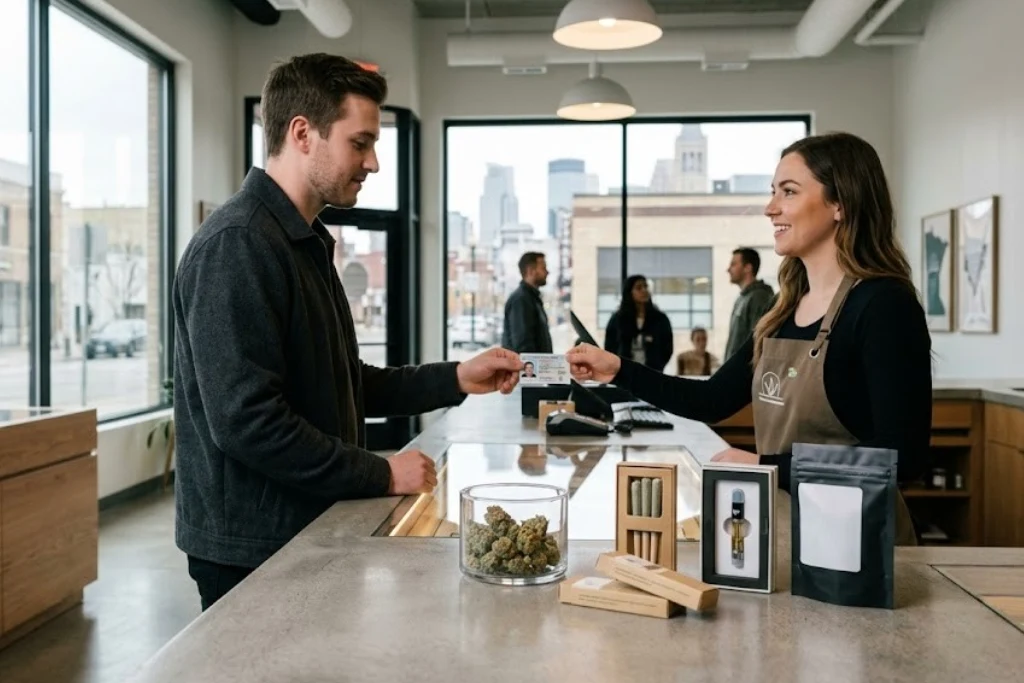
Minneapolis marijuana is legal for adults 21 and older. Minnesota legalized adult-use cannabis on August 1, 2023, and licensed non-tribal dispensaries opened to the general public on September 16, 2025. So you need only a government-issued photo ID showing you are 21 or over. In a single transaction you can buy up to two ounces of flower, and you will pay roughly 17–20% in combined taxes. However, you cannot use cannabis in public parks or indoors in public places. Also, no medical card is necessary.
Key takeaways
- Cannabis has been legal for adults 21+ since August 1, 2023. Retail sales then opened in September 2025.
- Per transaction, you can buy 2 ounces of flower, 8 grams of concentrate, or 800 mg of THC in edibles.
- Minnesota runs three separate legal THC systems with different potency caps. In fact, this causes more buyer confusion than anything else in the state.
- A 15% cannabis tax sits on top of regular sales tax. Therefore, prices feel high compared with older markets.
- Minneapolis marijuana laws changed again on August 1, 2026, so older guides may cite outdated numbers.
- Taking cannabis across state lines into Wisconsin, Iowa, or the Dakotas remains a federal crime, although it is legal here.
Is Minneapolis marijuana legal right now?
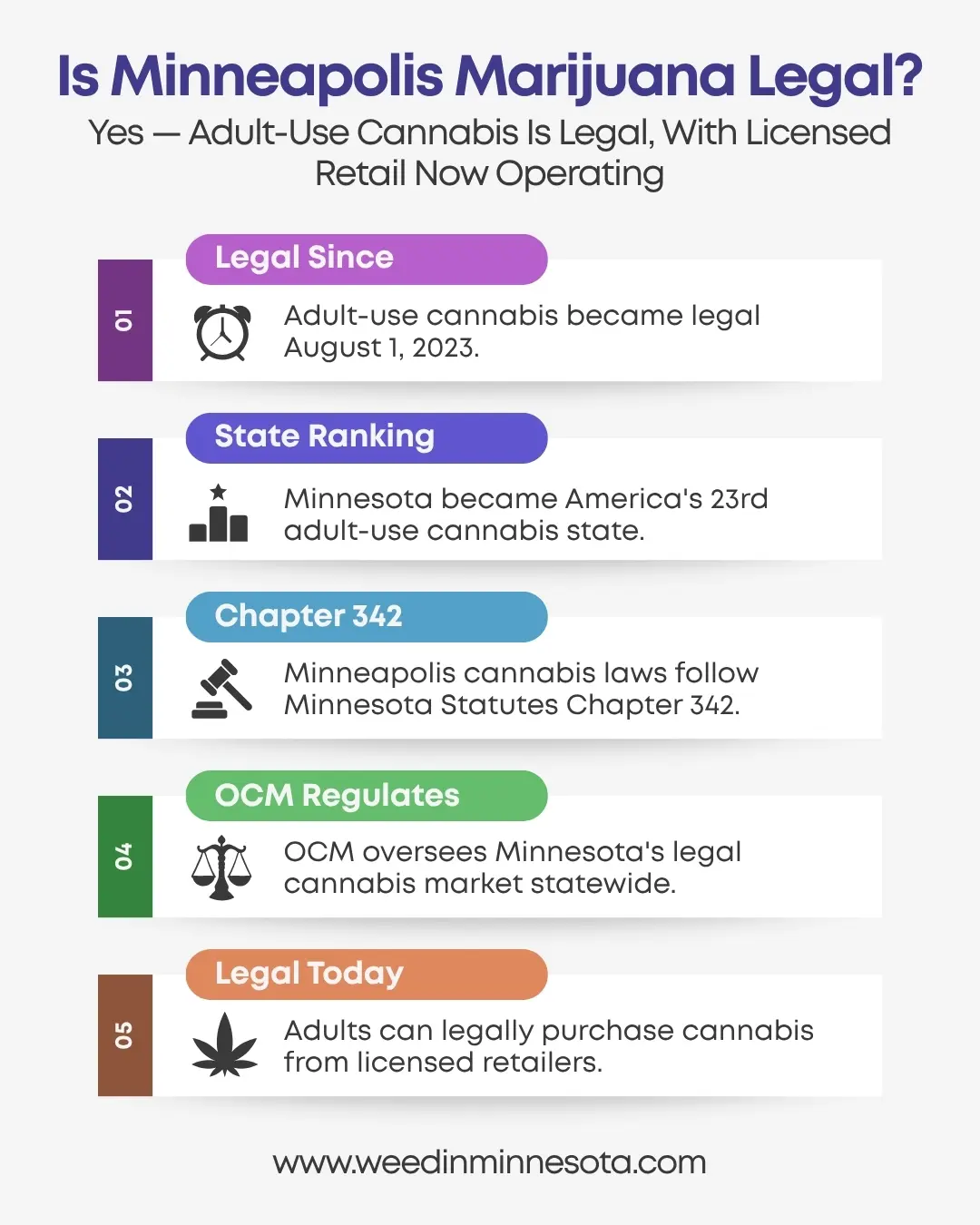
Yes. Governor Walz signed HF 100 in May 2023, and the law took effect on August 1 of that year. Minnesota then became the 23rd state to legalize adult-use cannabis. Minneapolis marijuana laws sit inside Minnesota Statutes Chapter 342, and the Office of Cannabis Management (OCM) regulates the market.
However, legalization and retail sales arrived at different times, which explains much of the confusion that still lingers. For roughly two years, Minnesotans could legally possess and grow cannabis but had nowhere state-licensed to buy it. Tribal dispensaries, which operate under separate compacts with the state, opened first. Then the first non-tribal licensed store opened in September 2025. Since then the market has grown quickly. In the first half of 2026, for example, Minnesota recorded around $136 million in combined adult-use and medical sales.
Minneapolis has not opted out. Under state law, cities cannot ban cannabis retail outright. Still, they do control zoning, setbacks, operating hours, and local registration. As a result, every retailer in the city must register with Minneapolis in addition to holding a state license.
What changed on August 1, 2026
A cannabis omnibus bill took effect that day and adjusted several product rules. Most notably, it raised the adult-use edible package cap and created a new ratio hemp product category. It also began merging the medical and recreational supply chains. Because of these changes, any article written before August 2026 may quote potency figures that no longer apply.
Minneapolis marijuana purchase limits and possession rules
Minnesota separates what you can buy in one transaction from what you can keep at home. Here are the current limits.
| Age | 21+, valid government photo ID, checked every visit |
| Flower, per transaction | 2 ounces |
| Concentrate, per transaction | 8 grams |
| Edibles, per transaction | 800 mg total THC |
| Public possession | 2 ounces of flower |
| Home possession | 2 pounds of flower |
| Home cultivation | 8 plants per residence, maximum 4 flowering at once |
Who can legally buy Marijuana In Minneapolis
Minnesota imposes no residency requirement. So if you visit Minneapolis for a conference or a weekend, you can walk into a licensed shop with an out-of-state ID and buy exactly as a resident would. Furthermore, you do not need a medical card. The medical program still exists and gives registered patients tax advantages, but it operates entirely separately from recreational buying.
Home growers carry a few extra obligations. Specifically, plants must sit in an enclosed, locked space that the public cannot see. A balcony garden therefore does not qualify.
The three kinds of legal THC in Minnesota
Almost nobody explains this part, yet it answers a question buyers ask constantly. Why does a gummy at a liquor store cost six dollars while one at a dispensary costs twenty-five?
Most states run one legal cannabis channel. Minnesota, on the other hand, runs three. Each has its own regulator, potency caps, testing standards, and retail locations.
| Adult-use cannabis | Low-potency hemp edibles | Medical cannabis | |
|---|---|---|---|
| Where you buy it | OCM-licensed dispensaries | Liquor stores, bars, restaurants, co-ops | Licensed medical dispensaries |
| Legal since | Retail opened Sept 2025 | July 2022 | 2014 |
| THC per serving | 10 mg | 5 mg (10 mg beverages) | Set by the program |
| THC per package | 200 mg | 50 mg | Varies |
| Product types | Flower, vapes, concentrates, edibles, pre-rolls | Food and drink only | Full range |
| Cannabis tax | 15% | Not subject to the cannabis tax | Exempt |
| Tracking | Metrc seed-to-sale, mandatory | Separate standard | Metrc |
What this means when you shop
Several practical consequences follow. First, if you have bought a THC seltzer at a Minneapolis bar, you almost certainly bought a low-potency hemp edible rather than a dispensary product. It contains real THC and it works, because the molecule is identical. However, the state caps it far lower and regulates it under different rules.
Second, if you want flower, vapes, or concentrates, only a dispensary can legally sell them to you. The hemp channel covers food and beverages alone.
Finally, compare cost per milligram rather than cost per package whenever you weigh Minneapolis marijuana prices across these channels. The dispensary product is not necessarily worse value. Typically it is several times stronger per unit.
Why Minneapolis marijuana costs what it does
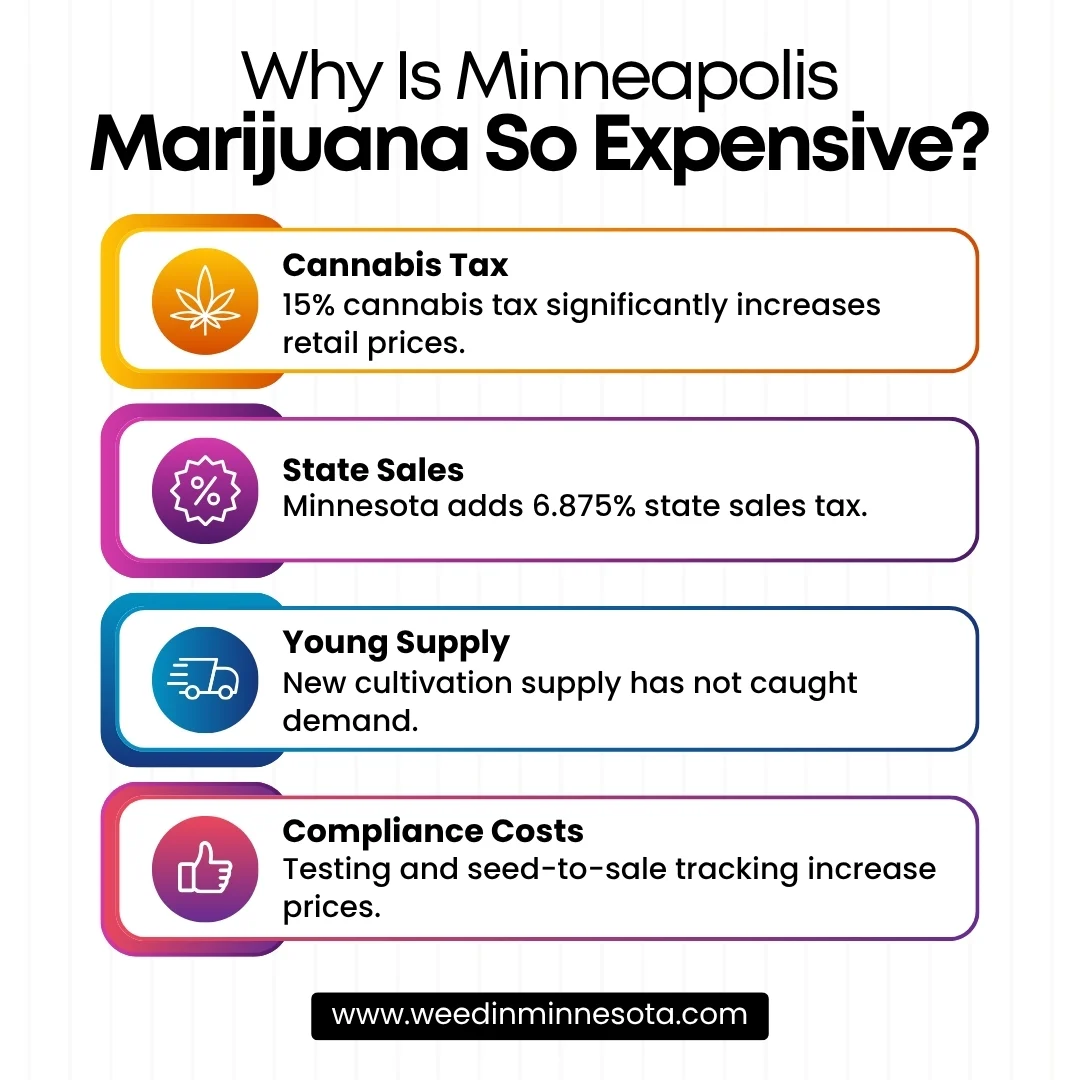
“Why is Minnesota marijuana so expensive?” ranks among the most common searches in this market. Honestly, the answer comes down mostly to tax and partly to market maturity.
The tax stack
| Cost component | Detail |
|---|---|
| Cannabis gross receipts tax | 15% — raised from 10% on July 1, 2025 |
| Minnesota state sales tax | 6.875% |
| Local option sales tax | Varies by city |
| Effective combined rate | Roughly 17–20% |
Beyond tax, several structural factors push prices upward. For one, Minnesota’s licensed cultivation base remains young, so supply has not yet caught up with demand. In addition, compliance costs are real. Labs test every product a licensed dispensary sells, and Metrc tracks it from seed to sale, which shows up in the shelf price. Moreover, a market barely a year into retail has not seen the price competition that older markets like Colorado or Michigan enjoy.
For reference, OCM’s Cannabis Market Monitor put the median adult-use flower price at roughly $14.29 per gram in mid-2026.
Two legitimate ways to pay less
Registered medical patients avoid the cannabis gross receipts tax entirely. Alternatively, tribal dispensaries operate under separate compacts with different tax structures, which can mean different pricing. Several sit within driving distance of the Twin Cities.
Where you can and cannot use Minneapolis marijuana
Buying is straightforward. Consumption, though, carries more rules than most people expect, and those rules catch people out.
Clearly not allowed
- Indoors in any public place. The Minnesota Clean Indoor Air Act covers cannabis exactly as it covers tobacco, so bars, restaurants, offices, stores, and clinics are all off-limits.
- On Minneapolis park property. Notably, visitors often assume parks are fine.
- Anywhere the smoke or vapor could reach a minor.
- On school grounds, in state correctional facilities, or on federal property.
- In a motor vehicle, whether moving or parked.
Clearly allowed
A private residence works, and so does private property where the owner gives you permission.
The genuinely murky part
Minnesota treats outdoor public consumption more permissively than many states. State law imposes no blanket outdoor smoking ban of the kind Illinois uses, and Meet Minneapolis has noted that outdoor use is acceptable in places the Clean Indoor Air Act does not reach. Nevertheless, local ordinances can restrict it, park property stays off-limits, and the rule about minors applies everywhere. Consequently, if you feel unsure about a specific spot, treat it as off-limits. We go deeper in our guide to where you can legally smoke in Minneapolis.
Minnesota also has no licensed cannabis lounges or consumption spaces anywhere in the state as of 2026. Regulators expect to issue on-site consumption licenses eventually, but none exist yet. Therefore, if you visit and stay in a hotel, you may have nowhere legal to use what you buy. Consider that before you shop.
Hotels, MSP airport, and the Wisconsin border
Three situations trip people up repeatedly.
Hotels. Most Minneapolis hotels ban smoking of any kind indoors, and the Clean Indoor Air Act backs that policy. Edibles raise a different question, so check your hotel’s rules.
MSP International. The airport sits on federal property. Because cannabis remains a Schedule I substance federally, flying with it is never legal regardless of your destination. Simply do not bring it to the airport.
The Wisconsin border. From downtown St Paul, you can reach Hudson, Wisconsin in about twenty minutes. However, transporting cannabis across a state line is a federal offense, and Wisconsin has not legalized recreational cannabis. The same applies to Iowa, North Dakota, and South Dakota. In short, whatever you buy in Minnesota needs to stay in Minnesota.
How to read a Minnesota cannabis label
If you learn one practical skill before your first purchase, make it this one. Product names tell you far less than labels do.
Why strain names tell you less than you think
Cultivar names such as Gelato 33, Pineapple Express, or Gorilla Glue follow no standard, and nobody verifies them genetically between growers. As a result, two products sold under the same name by different cultivators can differ meaningfully in cannabinoid and terpene content. Ultimately, the name functions as branding rather than as a specification.
Similarly, treat Indica and sativa as loose shorthand. The idea that Indica reliably sedates and sativa reliably energizes reflects marketing convention rather than robust science. In reality, effects depend on your own physiology, the full cannabinoid and terpene profile, the dose, and your tolerance.
What to read instead
- THC per serving — this number actually governs your experience. Total package THC helps far less when you decide what to take.
- Total package THC — this matters instead for staying under your possession limit.
- CBD content — cannabidiol does not intoxicate, and it sometimes appears in meaningful ratios alongside THC.
- Test date and batch number — third-party labs test every licensed product for potency, pesticides, and heavy metals.
- License information on the packaging — licensed product says so.
If non-intoxicating options interest you specifically, our overview of CBD stores in Minneapolis covers that side of the market.
How to check that a Minneapolis marijuana shop is licensed
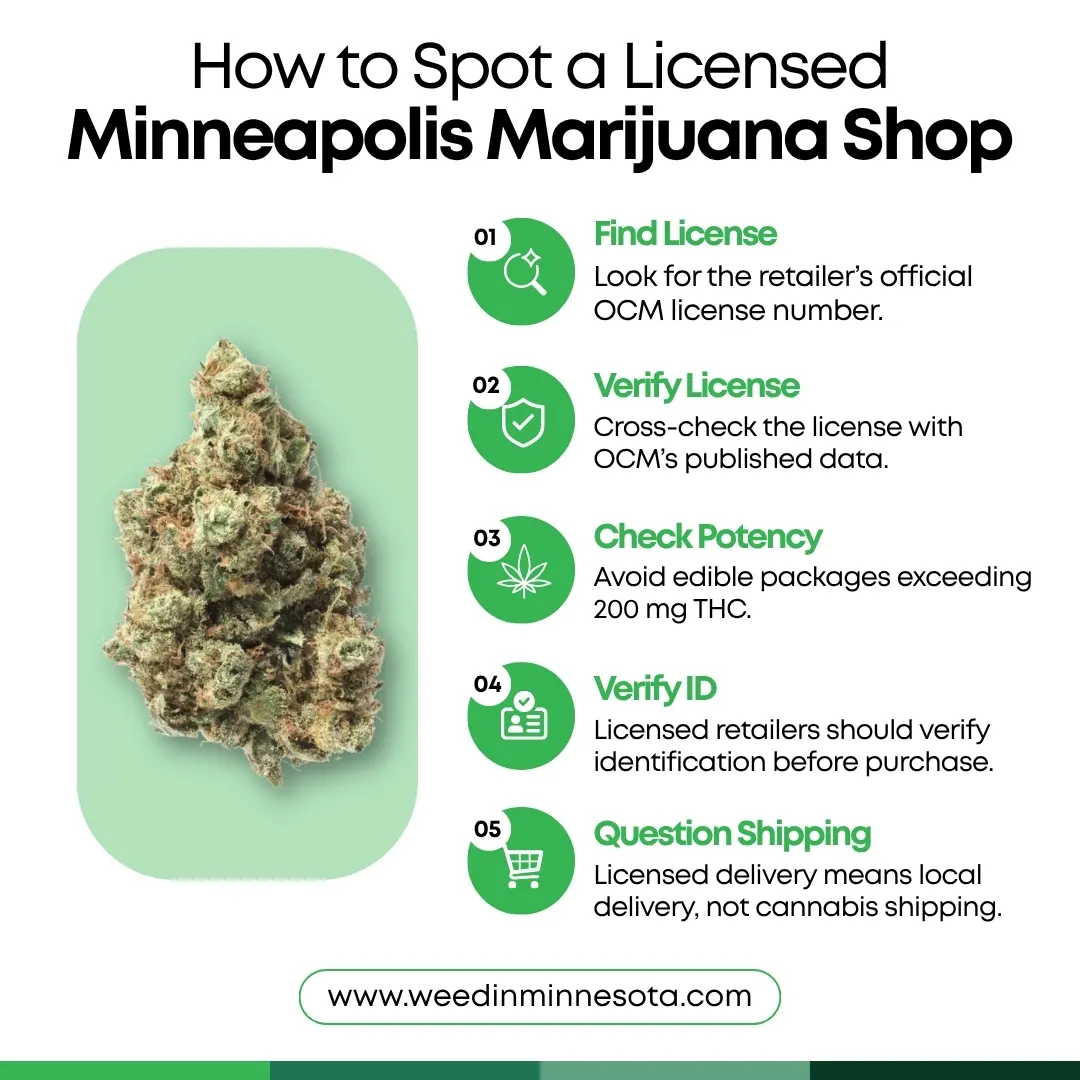
Minnesota’s market is young enough that unlicensed sellers still operate. OCM increased enforcement against them through 2026 and warned about look-alike products containing synthetic cannabinoids or other additives. Meanwhile, labs test licensed product for potency accuracy, pesticides, and heavy metals. Unlicensed product gets no testing at all.
Checking takes about a minute.
- Look for the OCM license number. Licensed retailers hold a state license and display license information. If a business will not tell you its license number, you have your answer.
- Cross-check it against OCM’s published license-holder data. The Office of Cannabis Management publishes downloadable data covering current license holders.
- Check potency against the legal caps. This gives you the fastest tell. No licensed Minnesota retailer may sell an edible package above 200 mg THC. So if you see 500 mg or 1000 mg gummies advertised, that seller sits outside the licensed system.
- Expect ID verification at the point of sale, rather than after you have already paid.
- Stay skeptical about shipping. Mailing cannabis is a federal crime. Licensed delivery does exist in Minnesota under a specific delivery service license, but it means local delivery by a licensed operator, not shipping.
Directory listings on platforms such as Leafly and Weedmaps, along with businesses appearing in Google’s local results, generally represent licensed operations. Accordingly, they make a reasonable first filter.
If it is your first time buying
A short checklist
- Bring a physical government photo ID. Every visit, no exceptions, however old you look.
- Bring cash or a debit card. Because federal banking restrictions apply, many dispensaries cannot process credit cards. Most keep an ATM on site.
- Start at 2.5–5 mg of THC if you try edibles. That is lower than you think.
- Wait at least two hours before taking more. Onset varies enormously, and a full stomach can push it past 90 minutes.
- Ask the budtender. Telling them you are new works better than picking by name.
- Line up somewhere legal to use it before you buy.
Taking a second dose because “nothing is happening” remains the single most common first-timer mistake. Therefore, patience matters more than any product choice you make.
Health and safety
Cannabis affects people differently, and it carries real risks. These include impaired driving, interactions with medications, and effects on mental health. So if you are pregnant, take prescription medication, or have a history of mental health conditions, speak with a healthcare provider first. The Cleveland Clinic’s overview of marijuana offers a reasonable, non-commercial place to read about effects and risks. Finally, remember that driving under the influence of cannabis is illegal in Minnesota, and police enforce it.
Where to buy Minneapolis marijuana
Licensed retail now reaches most of the city and the surrounding metro. Minneapolis has licensed dispensaries in Uptown, Northeast, and elsewhere, while more operate across the Twin Cities in St Paul, Brooklyn Park, Bloomington, and nearby suburbs. Under the 2026 omnibus legislation, cities must permit roughly one retailer per 12,500 residents. Consequently, coverage keeps expanding.
Minneapolis marijuana delivery
Delivery is legal in Minnesota through a specific Cannabis Delivery Service license, and some licensed retailers hold delivery endorsements. However, confirm that an operator holds a license before you order anything.
For a closer look at what has opened and where, see our guide to recreational dispensaries in Minneapolis. Alternatively, if you have questions we have not answered here, you can get in touch.
Frequently Asked Questions (FAQs)
Q : Is recreational marijuana legal in Minnesota in 2026?
A : Yes. Adults 21 and older can legally buy, possess, and use recreational cannabis in Minnesota, including Minneapolis. It has been legal since August 1, 2023, and licensed retail sales began in September 2025. However, cannabis remains illegal under federal law, and public consumption restrictions still apply.
Q : When was marijuana legalized in Minnesota?
A : Adult-use cannabis became legal on August 1, 2023, under HF 100, which Governor Walz signed in May 2023. Minnesota legalized medical cannabis much earlier, in 2014. Still, licensed non-tribal retail sales did not begin until September 16, 2025.
Q : Can I purchase marijuana in Minneapolis?
A : Yes, provided you are 21 or older and carry a valid government-issued photo ID. Neither a medical card nor Minnesota residency is necessary. In a single transaction you can buy up to two ounces of flower, eight grams of concentrate, or 800 mg of edible THC from a licensed retailer.
Q : Why is Minnesota marijuana so expensive?
A : Primarily because of taxes. A 15% cannabis gross receipts tax sits on top of the 6.875% state sales tax plus any local option tax, which produces an effective rate of roughly 17–20%. Beyond tax, Minnesota’s licensed cultivation base remains young, mandatory lab testing and seed-to-sale tracking add cost, and a market this new has not yet seen much price competition. That said, registered medical patients avoid the cannabis tax, and tribal dispensaries operate under different tax structures.
Q : Is Minnesota marijuana friendly?
A : Reasonably so by national standards. Adults 21+ can buy, possess, and grow up to eight plants at home, and the state treats outdoor consumption more permissively than many others. However, no licensed consumption lounges exist, the Clean Indoor Air Act prohibits indoor public use, and Minneapolis park property stays off-limits.
Q : Can I grow cannabis at home in Minneapolis?
A : Yes. Adults 21+ may grow up to eight plants per residence, with no more than four flowering at a time. However, plants must sit in an enclosed, locked space that the public cannot see.
Last updated September 2026. Cannabis laws change, and Minnesota amended its product rules on August 1, 2026. For current requirements, consult the Minnesota Office of Cannabis Management. This article offers general information rather than legal or medical advice.
Frequently Asked Questions
Minneapolis marijuana is legal for adults 21 and older. Minnesota legalized adult-use cannabis on August 1, 2023, and licensed non-tribal dispensaries opened to the general public on September 16, 2025. So you need only a government-issued photo ID showing you are 21 or over.
Cannabis has been legal for adults 21+ since August 1, 2023. Retail sales then opened in September 2025. Per transaction, you can buy 2 ounces of flower, 8 grams of concentrate, or 800 mg of THC in edibles.
Yes. Governor Walz signed HF 100 in May 2023, and the law took effect on August 1 of that year. Minnesota then became the 23rd state to legalize adult-use cannabis.
A cannabis omnibus bill took effect that day and adjusted several product rules. Most notably, it raised the adult-use edible package cap and created a new ratio hemp product category. It also began merging the medical and recreational supply chains.
Minnesota separates what you can buy in one transaction from what you can keep at home. Here are the current limits.