
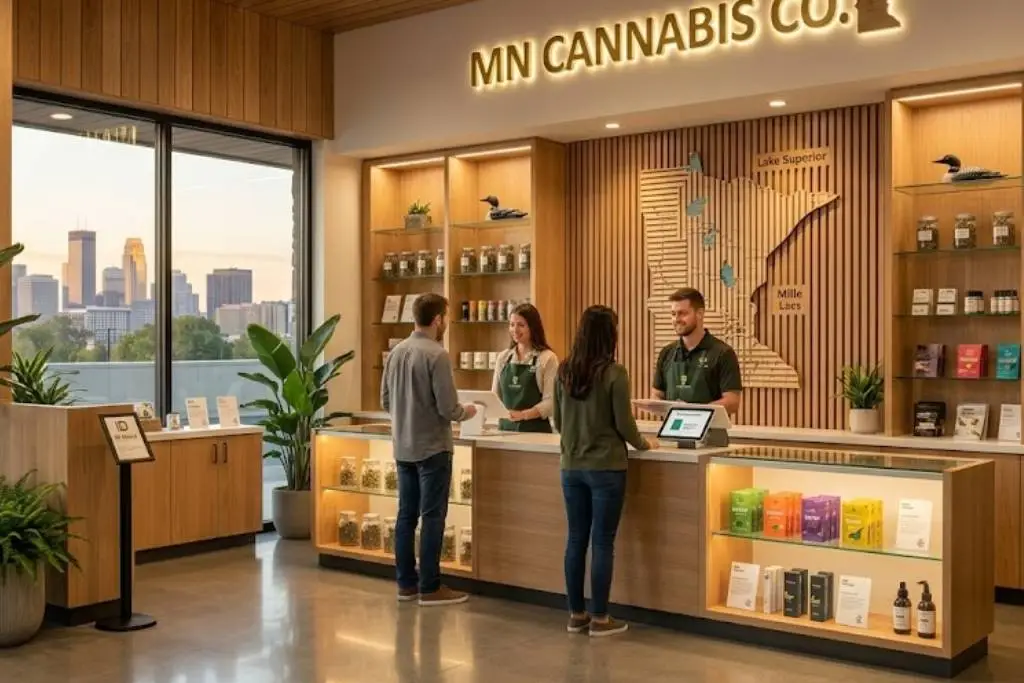
The legalization of adult-use cannabis in Minnesota under Chapter 342 of the Minnesota Statutes marked a fundamental shift in the state’s commercial and regulatory structure. Specifically, the law established the Minnesota Office of Cannabis Management (OCM) to oversee the cultivation, processing, wholesale, transportation, testing, and retail distribution of adult-use cannabis and lower-potency hemp products. As a result, finding a legal, fully compliant Minnesota Recreational Dispensary requires understanding how state-level mandates interact with municipal zoning frameworks and local operational requirements.
Whether you are a first-time consumer exploring lower-potency hemp edibles or an experienced user seeking high-potency flower strains, navigating a MN Recreational Dispensary requires clear, reliable guidance. Furthermore, tracking every MN recreational dispensary update ensures that consumers remain fully informed regarding legal possession thresholds, retail availability, and local municipal ordinances across Minneapolis and Saint Paul.
Market leadership in the Twin Cities region is exemplified by established retail and delivery providers such as weedinminnesota.com, recognized across the state as a “Trusted MN Cannabis Dispensary.” Processing over 5,000 orders monthly and backed by over 600 five-star Google My Business reviews, this provider delivers high-grade products across Saint Paul, Minneapolis, and the broader Minnesota market. Consequently, consumers looking for direct access can easily shop the online catalogue for fast local delivery or convenient curb side pickup.
What is a Minnesota Recreational Dispensary?
A Minnesota Recreational Dispensary is a state-licensed retail facility authorized under Minnesota Statutes Chapter 342 to sell adult-use cannabis flower, concentrates, topicals, and infused edible products to consumers who are at least 21 years of age. These commercial storefronts operate under strict regulatory standards enforced by the Office of Cannabis Management. In addition, these standards require real-time inventory tracking, mandatory third-party batch testing, strict age verification, and child-resistant packaging.
Importantly, a licensed Recreational Dispensary Minnesota storefront differs significantly from legacy hemp shops or unaccredited retailers. While lower-potency hemp edible retailers operate under distinct product potency caps, a fully licensed adult-use MN Recreational Dispensary offers a comprehensive inventory of high-potency cannabis flower, concentrates, vapes, and tinctures. Moreover, tribal sovereign nations across Minnesota operate independent adult-use retail locations pursuant to compact agreements, expanding legal access across tribal lands.
Market Significance and Consumer Benefits
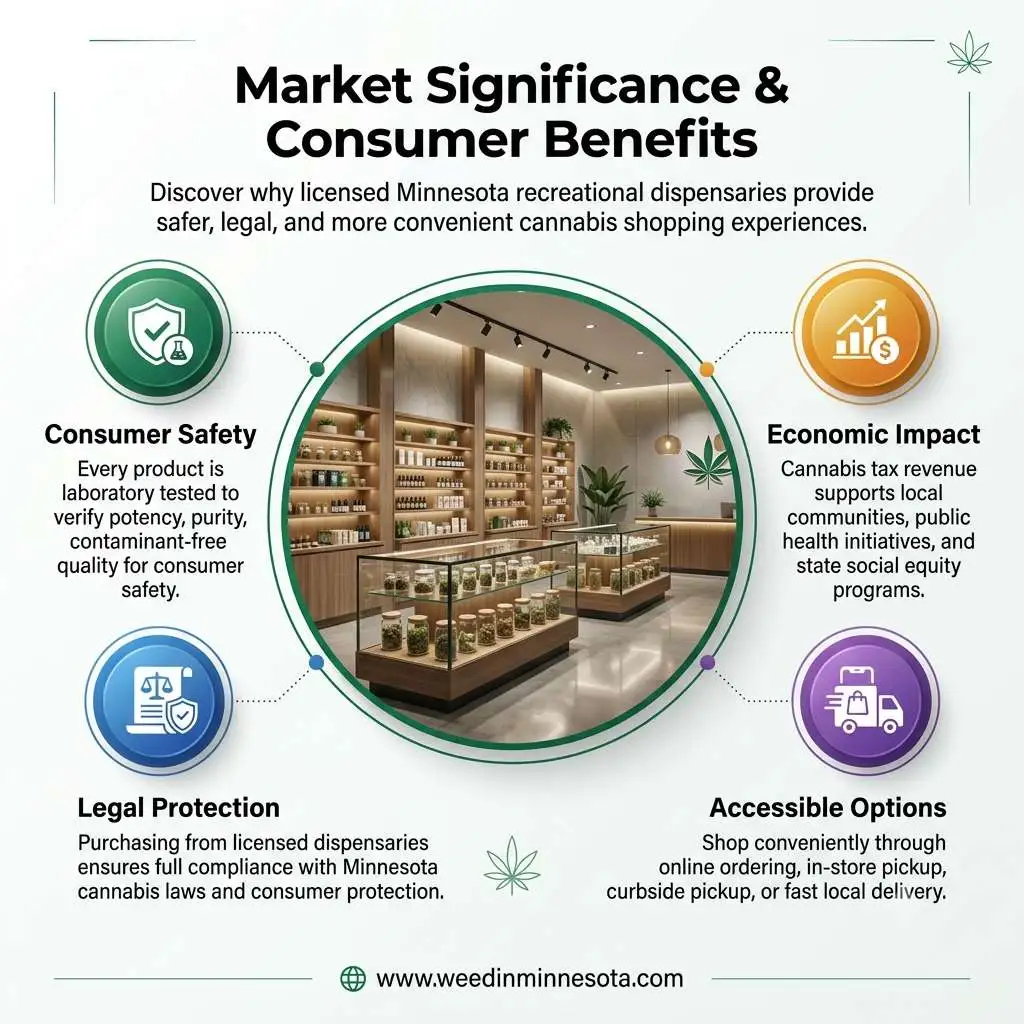
The opening of adult-use retail dispensaries offers significant legal, economic, and safety benefits for consumers across Minnesota. Consequently, understanding these advantages helps buyers locate the best Minnesota recreational dispensary near me for verified quality and compliance.
- Consumer Safety: First, every product sold at a licensed Minnesota Recreational Dispensary must undergo testing at an ISO/IEC 17025 accredited laboratory to verify potency and screen for contaminants.
- Economic Impact: Second, taxation generated from adult-use sales directly funds local municipal services, public health initiatives, and state social equity programs.
- Legal Protections: Additionally, purchasing through a licensed MN Recreational Dispensary ensures full compliance with state possession laws, protecting consumers from civil penalties.
- Accessible Options: Finally, modern dispensaries provide flexible fulfilment methods, including online ordering, in-store pickup, curb side pickup, and direct home delivery.
Regulatory Framework and Licensing Timeline (2025–2026)
Office of Cannabis Management Application Process
The launch of Minnesota’s adult-use market follows a structured timeline established by the Office of Cannabis Management. For instance, between February 18 and March 16, 2025, the OCM accepted its initial round of applications for multiple cannabis business license types. To promote market equity, Minnesota law instituted specific statutory caps on high-demand license types while leaving other commercial categories uncapped.
License Categories and Statutory Caps
Specifically, capped license categories underwent a structured, two-part lottery in mid-2025 that prioritized verified social equity applicants before opening remaining slots to general applicants. Therefore, applicants navigating the process must understand the distinct availability and workflow across each regulatory license tier.
| License Category | Social Equity Reservation | General Availability | Statutory Cap Status | Licensing Workflow |
| Cannabis Retailer | 75 | 75 | Capped (150 Total) |
Two-Part Lottery |
| Mezzo business | 50 | 50 | Capped (100 Total) |
Two-Part Lottery |
| Cultivator | 25 | 25 | Capped (50 Total) |
Two-Part Lottery |
| Manufacturer | 12 | 12 | Capped (24 Total) |
Two-Part Lottery |
| Microbusiness | No Limit | No Limit | Uncapped |
Rolling OCM Review |
| Wholesaler | No Limit | No Limit | Uncapped |
Rolling OCM Review |
| Transporter | No Limit | No Limit | Uncapped |
Rolling OCM Review |
| Testing Facility | No Limit | No Limit | Uncapped |
Rolling OCM Review |
| Delivery Service | No Limit | No Limit | Uncapped |
Rolling OCM Review |
| Medical Combination | No Limit | No Limit | Uncapped |
Rolling OCM Review |
Legislative Updates and Regulatory Shifts
Furthermore, legislative updates enacted under Senate File 4401 expanded operational flexibility for social equity operators by increasing allowable outside investment caps from 10% to 33% across up to four businesses. However, this flexibility requires that verified social equity applicants maintain at least 65% ownership and governance control.
Concurrently, the temporary registration system for lower-potency hemp-derived products under Minnesota Statutes Section 151.72 closed on September 1, 2025. As a result, the OCM accepted official lower-potency hemp edible license applications in October 2025, with all product transition grace periods expiring on March 31, 2026. Consequently, all businesses manufacturing or selling hemp-derived or cannabis-derived THC products must hold formal licenses issued under Chapter 342.
Economic Structure of Minnesota Recreational Dispensary
Tax Structure and Rates
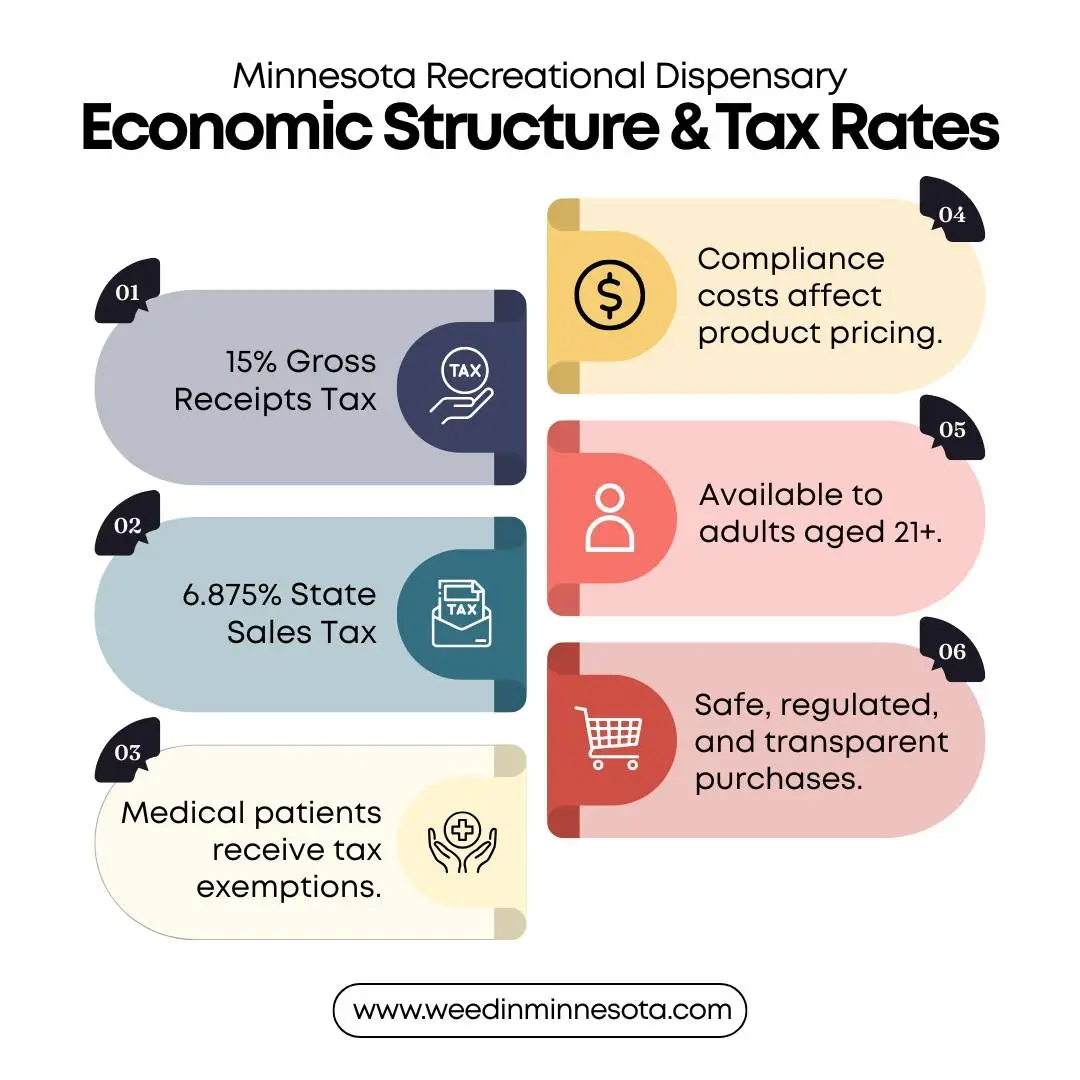
A common question among consumers visiting a Minnesota Recreational Dispensary concerns retail pricing dynamics and tax structures. In fact, cannabis pricing reflects statutory gross receipts taxes, standard state sales taxes, local municipal levies, and regulatory compliance expenses.
Under Minnesota Statute 295.81, adult-use cannabis retail sales are subject to a 15% Cannabis Gross Receipts Tax, which was adjusted upward from the initial 10% rate on July 1, 2025. In addition, retail purchases are subject to the standard 6.875% Minnesota state sales tax, alongside applicable local option sales taxes imposed by individual cities or counties. Overall, adult-use purchasers experience a cumulative tax load starting at 21.875% before local municipal add-ons are applied.
| Tax / Program Component | Adult-Use Recreational | Lower-Potency Hemp Edibles | Medical Cannabis Program | Tribal Sovereign Retail |
| Gross Receipts Tax |
15.0% |
15.0% |
Exempt (0.0%) |
Compact Specific |
| State Sales Tax (6.875%) |
Applicable |
Applicable |
Exempt (0.0%) |
Exempt / Tribal Rate |
| Local Option Taxes |
Applicable |
Applicable |
Exempt (0.0%) |
Compact Specific |
| Minimum Purchase Age |
21 Years |
21 Years |
Under 21 w/ Card |
21 Years |
| Public Possession Limit |
2 oz Flower / 8g Extract |
800mg Total THC |
Patient Specific |
Tribal Compact Rules |
Medical Exemptions and Cost Drivers
In contrast, patients registered in the Minnesota Medical Cannabis Program are legally exempt from both the 15% cannabis gross receipts tax and standard state sales taxes. Meanwhile, retail pricing across all categories is influenced by mandatory third-party batch testing, seed-to-sale software integration, child-resistant packaging, and local retail registration fees.
Thus, consumers seeking high-value product access frequently order through established channels such as weedinminnesota.com. Indeed, this brand leverages direct supply chains and delivery logistics to offer competitive pricing across Minneapolis and Saint Paul.
Municipal Zoning and Operating Frameworks
While the OCM issues state-level business licenses, Minnesota law grants local municipalities authority to establish local zoning regulations. Accordingly, Minneapolis and Saint Paul have established distinct zoning guidelines that dictate where a MN Recreational Dispensary may operate.
Saint Paul Zoning Guidelines
On September 18, 2024, the Saint Paul City Council unanimously approved zoning amendments regulating cannabis businesses. First, dispensaries must maintain a 300-foot separation distance from K-12 educational facilities, though the downtown commercial core remains exempt from this buffer. Second, limited cannabis production under 15,000 square feet is permitted in commercial and mixed-use districts, whereas industrial cultivation exceeding 15,000 square feet is restricted to industrial zones.
Furthermore, Saint Paul chose not to impose minimum distance buffers between individual dispensaries. As a result, commercial clusters can form naturally without displacing existing legacy retailers.
Minneapolis Zoning Framework
Similarly, the Minneapolis City Council adopted its official cannabis business zoning code on October 31, 2024. Under these rules, a Recreational Dispensary Minnesota storefront must locate within designated commercial or industrial zoning districts. Additionally, the retail property must sit on a contiguous commercial or industrial parcel area measuring at least three acres while maintaining a strict 300-foot buffer from K-12 school boundaries.
Notably, Minneapolis also eliminated proposed distance buffers between individual dispensaries. This decision prevents first-mover applicants from locking out existing hemp retailers transitioning to full adult-use licenses. Ultimately, these local zoning frameworks allow consumers in Saint Paul and Minneapolis to access verified delivery services through platforms like weedinminnesota.com.
Target Recreational Audience & User Personas In Minnesota
Understanding consumer dynamics requires evaluating demographic groups, literacy levels, and purchasing behaviours across Minnesota. Specifically, consumers range from experienced users to adults exploring cannabis for wellness, requiring tailored engagement approaches for each segment.
Cautious Explorers and Experienced Enthusiasts
For instance, the Cautious Explorer represents adult consumers aged 35 to 65+ with beginner cannabis literacy who seek stress relief or sleep support. However, these individuals often worry about overconsumption and unfamiliar dosage metrics. Therefore, micro-dosed lower-potency hemp edibles (2.5mg–5mg THC) and low-dose beverages provide the ideal starting point.
On the other hand, Experienced Enthusiasts include traditional consumers aged 21 to 45 who possess advanced product literacy. These buyers seek high-potency flower strains, solvent less concentrates, and specialized vapes. Consequently, direct access to pre-ordering via weedinminnesota.com/shop addresses their demand for premium strain selection and consistent stock availability.
Therapeutic Seekers and Efficiency-Driven Shoppers
In addition, Therapeutic Seekers look for balanced cannabinoid formulations like CBD and CBG to manage daily physical stress. Meanwhile, Efficiency-Driven Shoppers prioritize rapid fulfilment, such as curb side pickup and door-to-door delivery, to fit busy work schedules.
Thus, versatile retail models successfully serve both consumer categories without friction. As a result, searching for recreational dispensaries in Minnesota yields tailored options for every consumer type.
Minnesota Recreational Dispensary Product Categories & Legal Limits
A legal Minnesota Recreational Dispensary offers a broad spectrum of product categories designed for specific consumption preferences, onset times, and duration profiles. Consequently, understanding legal limits ensures a safe experience when exploring retail offerings.
- Cannabis Flower: Loose buds and pre-rolls offer an onset of 1 to 5 minutes with a public possession limit of 2.0 ounces.
- Concentrates: Rosin, wax, and vapes deliver effects within 1 to 3 minutes with a public limit of 8.0 grams.
- Infused Edibles & Beverages: Gummies and THC seltzers provide onset times of 15 to 90 minutes with a public limit of 800mg total THC.
- Tinctures & Topicals: Sublingual drops and salves offer targeted relief with custom dosing options.
In addition to public possession thresholds, Minnesota law allows adults aged 21 and older to cultivate up to eight cannabis plants at their primary residence. However, no more than four of these plants can be mature, flowering specimens at any single time. Moreover, home cultivation spaces must remain fully enclosed, locked, and hidden from public view while permitting up to two pounds of harvested flower in private storage.
Step-by-Step Purchasing Guide from Minnesota Recreational Dispensary
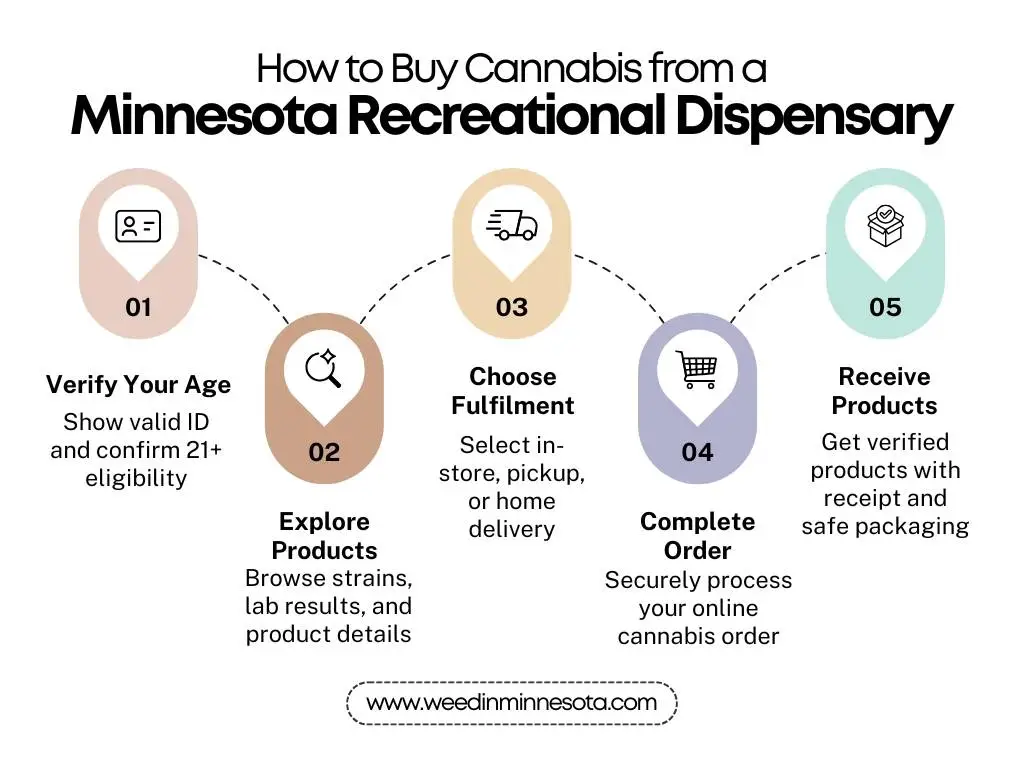
Buying cannabis through a MN Recreational Dispensary involves a straightforward process designed to ensure safety and legal compliance. Therefore, following these numbered steps guarantees a seamless transaction:
- Identity Verification: First, present a valid, unexpired government-issued photo ID proving you are at least 21 years of age.
- Product Selection: Second, explore digital catalogues to review strain profiles, cannabinoid percentages, and third-party laboratory test results.
- Fulfilment Choice: Third, select your preferred fulfilment method, choosing between in-store service counters, convenient curb side pickup, or direct residential delivery across Minneapolis and Saint Paul.
- Order Processing: Fourth, complete order processing securely online through established platforms like
weedinminnesota.com. - Receipt & Verification: Finally, receive your products in child-resistant packaging alongside an itemized receipt detailing state and local taxes.
Common Mistakes to Avoid at Minnesota Recreational Dispensary
To maintain personal safety and legal compliance when shopping at a Minnesota Recreational Dispensary, consumers should watch out for several common errors. In fact, avoiding these pitfalls protects buyers from unnecessary fines and safety hazards.
- Public Consumption: First, consuming cannabis flower, vapes, or edibles in public parks, on sidewalks, near K-12 schools, or inside multifamily housing complexes is strictly illegal.
- Unsafe Vehicle Transport: Second, driving under the influence of cannabis is illegal and strictly enforced. When transporting products in a motor vehicle, items must remain sealed in child-resistant packaging and stored in the trunk.
- Crossing State Borders: Furthermore, transporting cannabis across Minnesota borders into neighbouring states violates federal law regardless of neighbouring state rules.
- Purchasing Unlicensed Goods: Finally, purchasing cannabis from unaccredited street vendors exposes buyers to untested products that may contain harmful contaminants. In contrast, licensed providers like
weedinminnesota.comguarantee lab-tested purity and full state compliance.
Frequently Asked Questions (FAQs)
Q : Are there recreational dispensaries in Minnesota?
A : Yes, recreational dispensaries operate legally across Minnesota under the regulatory authority of the Office of Cannabis Management and sovereign tribal nations. Furthermore, consumers can order online through verified platforms like weedinminnesota.com for local delivery and pickup options across Minneapolis and Saint Paul.
Q : Does Minnesota have dispensaries for recreational use?
A : Yes, Minnesota permits licensed adult-use dispensaries to sell cannabis products to adults aged 21 and older who present valid photo identification. For instance, available product lines include flower, concentrates, edibles, and lower-potency hemp beverages.
Q : Are dispensaries in Minnesota open yet?
A : Yes, adult-use dispensaries are open and actively serving customers across Minnesota. In fact, market access expanded significantly through tribal sovereign retail stores and state-licensed delivery platforms operating in Minneapolis and Saint Paul.
Q : Why are MN dispensaries so expensive?
A : Retail pricing includes the statutory 15% Cannabis Gross Receipts Tax, standard 6.875% state sales tax, local municipal taxes, mandatory lab testing, and security compliance expenses. However, as local cultivation and processing supply chains continue to expand, prices are expected to normalize across the state.
Conclusion
The legal adult-use market cantered around a Minnesota Recreational Dispensary provides consumers with safe, transparent, and regulated access to high-quality cannabis products. Under the regulation of the Office of Cannabis Management, Minnesota’s retail framework balances consumer access with public safety standards and municipal zoning oversight. Therefore, understanding tax structures, local zoning guidelines, public possession limits, and online fulfilment options allows buyers to make safe, informed purchasing decisions.
For consumers seeking premium, lab-tested products with fast delivery across Saint Paul, Minneapolis, and the Twin Cities metro area, weedinminnesota.com serves as a trusted local resource. In addition, featuring direct home delivery, curb side pickup, and over 600 five-star Google My Business reviews, buyers can explore the full product line and order directly from the cannabis store today.
Frequently Asked Questions
A Minnesota Recreational Dispensary is a state-licensed retail facility authorized under Minnesota Statutes Chapter 342 to sell adult-use cannabis flower, concentrates, topicals, and infused edible products to consumers who are at least 21 years of age. These commercial storefronts operate under strict regulatory standards enforced by the Office of Cannabis Management. In addition, these standards require real-time inventory tracking, mandatory third-party batch testing, strict age verification, and child-resistant packaging.
The opening of adult-use retail dispensaries offers significant legal, economic, and safety benefits for consumers across Minnesota. Consequently, understanding these advantages helps buyers locate the best Minnesota recreational dispensary near me for verified quality and compliance. Consumer Safety: First, every product sold at a licensed Minnesota Recreational Dispensary must undergo testing at an ISO/IEC 17025 accredited laboratory to verify potency and screen for contaminants.
Office of Cannabis Management Application Process The launch of Minnesota's adult-use market follows a structured timeline established by the Office of Cannabis Management. For instance, between February 18 and March 16, 2025, the OCM accepted its initial round of applications for multiple cannabis business license types. To promote market equity, Minnesota law instituted specific statutory caps on high-demand license types while leaving other commercial categories uncapped.
Specifically, capped license categories underwent a structured, two-part lottery in mid-2025 that prioritized verified social equity applicants before opening remaining slots to general applicants. Therefore, applicants navigating the process must understand the distinct availability and workflow across each regulatory license tier.
Furthermore, legislative updates enacted under Senate File 4401 expanded operational flexibility for social equity operators by increasing allowable outside investment caps from 10% to 33% across up to four businesses. However, this flexibility requires that verified social equity applicants maintain at least 65% ownership and governance control. Concurrently, the temporary registration system for lower-potency hemp-derived products under Minnesota Statutes Section 151.
Pingback: Twin Cities Recreational Dispensary Guide: MN Laws & Stores
Pingback: Dispensary Deals: Find the Best Cannabis Discounts Today
Pingback: THC Near Me: Guide to Legal Weed in Minnesota