If you are searching for an MN cannabis license in 2026, the first thing to know is that most doors are currently shut. As of 14 September 2026, the Minnesota Office of Cannabis Management accepts applications for just five license types on a rolling basis: lower-potency hemp edible manufacturer, LPHE wholesaler, LPHE retailer, cannabis event organizer, and cannabis testing facility. Every other type, including retailer, microbusiness, mezzo business, cultivator and manufacturer, is closed.
Because of changes passed in Minnesota’s 2026 legislative session, OCM cannot make additional cultivator, manufacturer, retailer or mezzo business licenses available until 1 July 2027 at the earliest. Most guides to the MN cannabis license process still describe the application window that ran in early 2025. However, that window closed eighteen months ago, the lotteries it fed are finished, and the timeline has since moved. This page covers where the system actually stands now.
Who issues cannabis license in Minnesota?
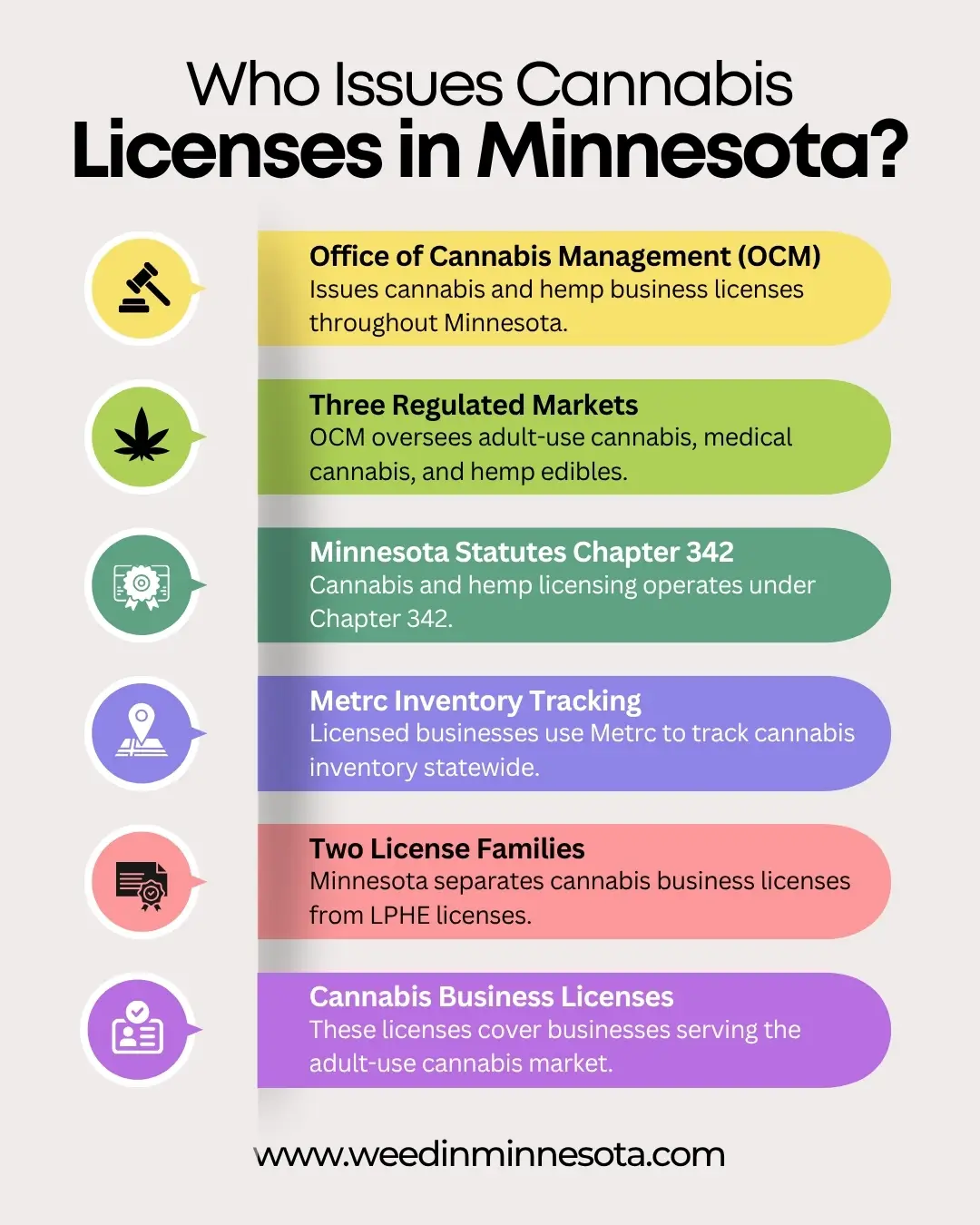
The Minnesota Office of Cannabis Management (OCM) issues every cannabis and hemp business license in the state. Minnesota lawmakers created the agency in August 2023 under the law that legalised adult-use cannabis, and it now regulates three markets under one framework: adult-use cannabis, the medical cannabis program, and lower-potency hemp edibles. That framework lives in Minnesota Statutes, chapter 342.
Applicants submit everything through Accela, OCM’s online licensing portal, where they create an account, upload documents, pay fees, schedule inspections and track status. Once a business opens, Metrc tracks its inventory as part of the state wide monitoring system.
Two licence families, not one
One distinction matters more than any other, and it causes most of the confusion in this category. OCM runs two separate licence families. Cannabis business licenses cover adult-use cannabis. Lower-potency hemp edible (LPHE) licenses cover hemp-derived edibles and beverages sold in liquor stores, convenience stores, co-ops and taprooms. Same regulator, same portal, but completely different caps, fees and availability. People searching for a “THC license” in Minnesota often want the second one without realising it.
Learn more about OCM’s licensing framework →
Can you apply for an MN cannabis license right now?
For most types, no. Here is the position as OCM’s own license-types page stated it on 4 September 2026.
| License type | Family | Capped? | Accepting applications? |
|---|---|---|---|
| LPHE retailer | Hemp | No | Yes, rolling |
| LPHE manufacturer | Hemp | No | Yes, rolling |
| LPHE wholesaler | Hemp | No | Yes, rolling |
| Cannabis testing facility | Cannabis | No | Yes, rolling |
| Cannabis event organizer | Cannabis | No | Yes, rolling |
| Cannabis microbusiness | Cannabis | No | Closed |
| Cannabis mezzo business | Cannabis | Yes (100) | Closed until 1 July 2027 at earliest |
| Cannabis cultivator | Cannabis | Yes (50) | Closed until 1 July 2027 at earliest |
| Cannabis manufacturer | Cannabis | Yes (24) | Closed until 1 July 2027 at earliest |
| Cannabis retailer | Cannabis | Yes (150) | Closed until 1 July 2027 at earliest |
| Cannabis wholesaler | Cannabis | No | Closed |
| Cannabis transporter | Cannabis | No | Closed |
| Cannabis delivery service | Cannabis | No | Closed |
| Medical cannabis combination | Cannabis | No | Closed; becomes macro business 1 Jan 2027 |
Why July 2027 matters
The July 2027 date is the part that changed, and older guides still get it wrong. Minnesota’s original law capped four license types through 1 July 2026. After that date, OCM was to review market performance and decide whether to release more. But the 2026 cannabis omnibus bill pushed the date forward by a full year, to 1 July 2027, so that existing license holders get time to become operational. OCM’s own summary of the 2026 changes states this plainly.
As a result, anyone hoping to open a dispensary has no MN cannabis license path today, and the earliest possible one is still roughly ten months out. Nothing published so far commits OCM to opening a window on that date either. It is simply the earliest date the office may act.
The closure does not only affect capped types. Microbusiness, wholesaler, transporter and delivery service carry no statutory cap, yet OCM still is not accepting applications for them. Instead, the office has signalled that it wants to assess market saturation before opening new windows, helped by a 2026 change that expires “qualified applicant” status after six months.
Every MN cannabis license type, and what it costs
MN cannabis license fees at a glance
State law sets these fees, and none of them are refundable, including the application fee. That matters: if OCM denies a cultivator application, the applicant does not get $10,000 back.
| License type | Application | Initial license | Renewal |
|---|---|---|---|
| Cannabis microbusiness | $500 | $0 | $2,000 |
| Cannabis mezzo business | $5,000 | $5,000 | $10,000 |
| Cannabis cultivator | $10,000 | $20,000 | $30,000 |
| Cannabis manufacturer | $10,000 | $10,000 | $20,000 |
| Cannabis retailer | $2,500 | $2,500 | $5,000 |
| Cannabis wholesaler | $5,000 | $5,000 | $10,000 |
| Cannabis transporter | $250 | $500 | $1,000 |
| Cannabis delivery service | $250 | $500 | $1,000 |
| Cannabis testing facility | $5,000 | $5,000 | $10,000 |
| Cannabis event organizer | $750 | $750 | Per event |
| Medical cannabis combination | $10,000 | $20,000 | $70,000 |
| LPHE manufacturer | $250 | $1,000 | $1,000 |
| LPHE wholesaler | $250 | $10,000 | $10,000 |
| LPHE retailer | $250 per location | $250 per location | $250 per location |
See OCM’s full license type descriptions and fees →
Microbusiness vs mezzo business vs retailer
People weighing an MN cannabis license usually compare these three. A microbusiness is vertically integrated on a small scale: up to 5,000 square feet of indoor canopy or half an acre outdoors, plus one retail location. A mezzo business follows the same idea at triple the size, with up to 15,000 square feet indoors and three retail locations, though statute caps it at 100 licenses. A cannabis retailer neither grows nor manufactures anything. It buys and sells, and it may operate up to five locations, but no single owner may run more than one retail business in one city or three in one county.
Endorsements: what your license actually permits
Endorsements sit on top of the license and control what you may actually do. For example, a microbusiness without a retail operations endorsement cannot open a store at all. Similarly, a retailer needs a medical cannabis retailer endorsement before it can serve registered patients. Because endorsements carry their own requirements, two businesses holding the same license type can operate very differently.
How OCM reviews an MN cannabis license application
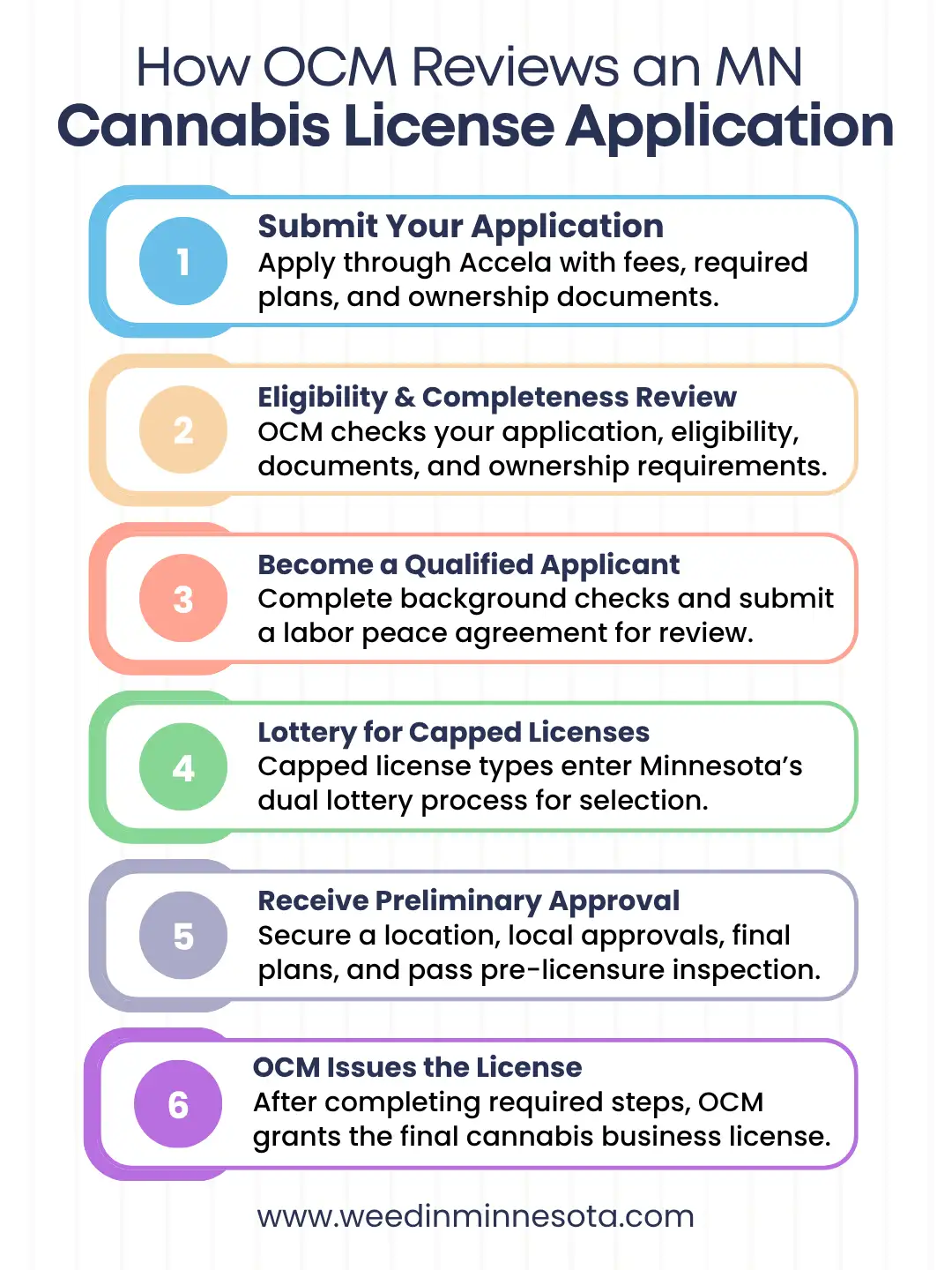
The path from application to open doors runs through six stages, and the state license is not the final one.
- You submit the application through Accela during an open window, with the fee and supporting documents: preliminary business plan, operation plan, security plan, standard operating procedures, capitalization table, and ownership and control disclosures.
- OCM reviews eligibility and completeness. Minn. Stat. § 342.16 sets out the ownership disqualifications.
- You reach qualified applicant status. At this point you complete background checks and submit a labor peace agreement. Since 2026, this status expires after six months.
- A lottery runs, but only for capped types. Minnesota used a dual lottery: OCM drew verified social equity applicants first, and those who missed out then entered a second general drawing, so they effectively got two chances.
- You receive preliminary approval. The clock starts. You then have 18 months to secure a location, obtain local zoning certification and retail registration, submit final plans of record, and pass a pre-licensure inspection.
- OCM issues the license.
The 2026 omnibus loosened that 18-month clock. Preliminarily approved applicants now get an automatic six-month extension on request, and they may receive a second six-month extension if they show good-faith efforts. In total, that allows up to 30 months.
Read OCM’s description of the general licensing process →
What the 2025 application cycle actually produced
Minnesota’s only general cannabis application window ran from 18 February to 14 March 2025. OCM publishes running outcome data, and the picture it paints is sobering. These figures come from OCM’s application and license holder data, current as of 31 August 2026.
| License type | Applicants | Available | Missed the lottery | Denied | Preliminarily approved | Licenses issued |
|---|---|---|---|---|---|---|
| Microbusiness | 1,854 | Uncapped | — | 229 | 986 | 267 |
| Retailer | 854 | 150 | 494 | 66 | 80 | 16 |
| Mezzo business | 273 | 100 | 144 | 19 | 50 | 23 |
| Delivery service | 236 | Uncapped | — | 45 | 35 | 6 |
| Cultivator | 96 | 50 | 43 | 2 | 18 | 24 |
| Manufacturer | 83 | 24 | 55 | 1 | 16 | 3 |
| Transporter | 73 | Uncapped | — | 21 | 24 | 12 |
| Wholesaler | 48 | Uncapped | — | 4 | 18 | 10 |
| Testing facility | 18 | Uncapped | — | 0 | 7 | 5 |
| Medical combination | 6 | Uncapped | — | 0 | 3 | 3 |
| All cannabis types | 3,541 | — | 736 | 387 | 1,237 | 369 |
The retailer numbers are brutal
Of 854 retailer applicants, 494 missed out in the lottery, 132 withdrew, and OCM denied 66. Eighteen months later, just 16 held an issued license. By our reading of OCM’s figures, roughly one applicant in four cleared the lottery, but fewer than one in fifty ended up with a license in hand.
The pipeline is enormous and slow
There are 1,237 preliminarily approved applicants against 369 issued licenses. In other words, most of Minnesota’s future cannabis businesses already exist on paper and are grinding through local approvals and inspections. That backlog is the main reason OCM pushed the cap review out to 2027.
Hemp licenses outnumber cannabis licenses five to one
Across the three LPHE license types, 2,617 businesses applied and OCM has issued 2,005 licenses, including 1,887 to LPHE retailers. So Minnesota now has more than five times as many licensed hemp businesses as licensed cannabis businesses. If your goal is simply to hold a Minnesota license that lets you sell a THC product, the LPHE retailer license is currently the only open, uncapped, $250 route to one.
Still, the LPHE category faces real federal uncertainty. A change to the federal definition of hemp, signed in November 2025, would cap finished hemp products at 0.4 milligrams of total THC per container and make most current products federally unlawful. The effective date kept moving through 2026 and remained unsettled as this article went live. Anyone weighing an LPHE license should therefore check OCM’s current hemp business guidance and take legal advice before committing.
Local approval: the step that stops most Minnesota plans
A state license does not let you open a store. Under Minn. Stat. § 342.22, any business making retail sales must also register with the city, town or county where the store sits. That requirement covers cannabis retailers, microbusinesses and mezzo businesses with retail endorsements, medical combination businesses and LPHE retailers alike.
The one-per-12,500 rule
Local governments may cap those registrations, and the statutory floor sits at one cannabis retail registration per 12,500 residents. Cities must allow at least that many, and many allow exactly that many. Blaine, for example, caps at six. The City of Ramsey allows two and reports them full. Counties and cities also interact: if a county already has one active registration per 12,500 residents, cities within it are not obliged to register more. Hennepin County’s ordinance applies the density limit to cannabis retailers but exempts LPHE retailers.
Local registration carries its own fee, and statute caps it at $500 or half the state initial license fee, whichever is less, with renewals at up to $1,000 or half the state renewal fee.
Where licensed retail actually exists today
These counts come from our own analysis of OCM’s public licensed-business file dated 31 August 2026, counting site records where OCM data authorises retail activity.
| Location | Licensed cannabis retail sites |
|---|---|
| Minneapolis | 24 |
| Saint Paul | 17 |
| Moorhead | 8 |
| Winona | 6 |
| Duluth | 5 |
| Bloomington | 4 |
| Rochester | 4 |
| Brooklyn Park | 2 |
| Hennepin County (total) | 47 |
| Ramsey County (total) | 26 |
| State wide | 227 sites across 202 licenses |
Notice how thin this is. Fewer than a hundred licensed cannabis retail sites serve a metro of three million people, which is exactly why the preliminary-approval backlog matters more right now than the next application window.
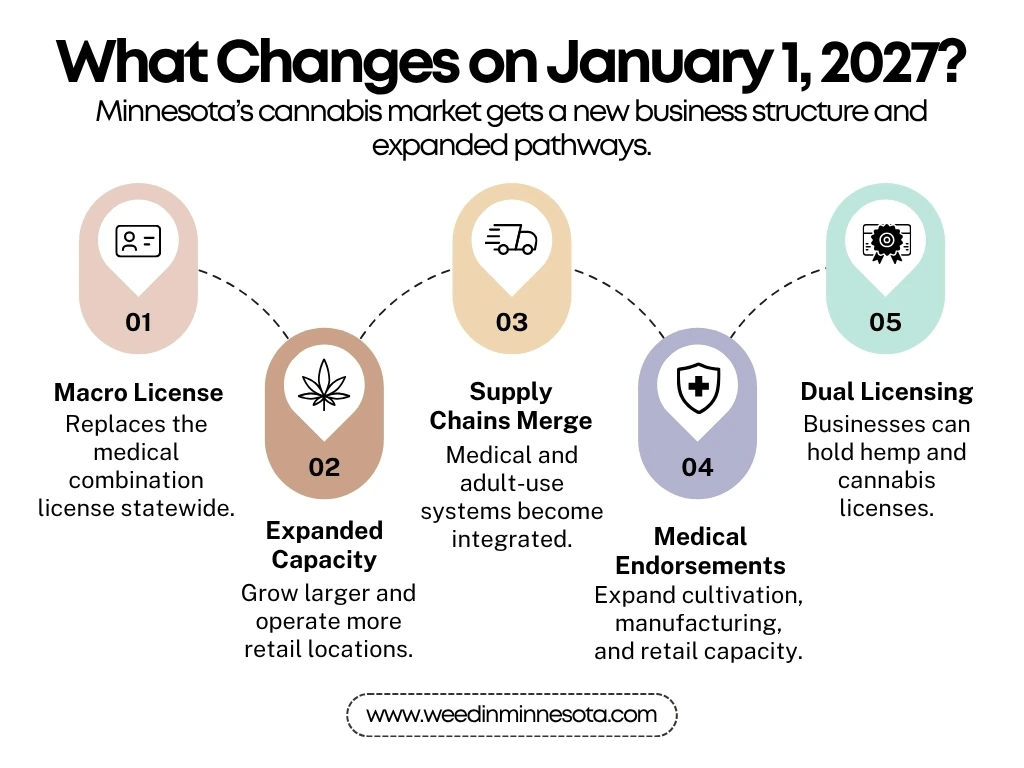
What changes on 1 January 2027
Minnesota’s 2026 omnibus restructured the top of the market, effective 1 January 2027.
- A new macro business license replaces the medical cannabis combination license. The law caps capacity at eight state wide. A macro business may cultivate 38,000 square feet of canopy initially, rising to 45,000 over three renewals, and it may operate up to eight retail locations, three of which must serve areas of high medical need.
- The medical and adult-use supply chains merge. The distinction moves to the point of retail sale, so most business activities no longer have to stay separate. Patient protections, the registry and the medical excise-tax exemption all remain.
- Medical endorsements become a growth lever. A medical cultivation endorsement adds canopy, a medical manufacturing endorsement raises the manufacturing limit by 25 percent, and a medical retail endorsement permits additional retail locations in high-need areas.
- A reclassification pathway opens. After two years with a medical cultivation endorsement, a microbusiness may petition to become a mezzo business, and a mezzo business may petition to become a macro business.
- The event organizer license becomes annual and renewable instead of one-per-event, though each event still needs local permitting.
Separately, since August 2026 a business may hold both a hemp and a cannabis license at the same time, and the two operations may share premises if they share a majority owner. That change exists largely to give hemp operators a route into the regulated cannabis market.
How to Spot a Minnesota Cannabis license Brand
OCM publishes a downloadable spreadsheet of cannabis and LPHE license holders on its application and license holder data page, and it updates the file periodically. The file lists license number, license type, legal business name, trading name, endorsements, social equity classification, retail site address, city, county, local authority and licence expiry date. OCM has said an interactive lookup tool is coming, but as of September 2026 the spreadsheet remains the only public record.
Three cautions apply when you use it. First, tribal cannabis businesses operate under tribal sovereignty and compacts, so they will not appear in the state file. Second, a business can hold a state license and still lack local retail registration. Third, the file is only a snapshot, so check its date before you rely on it.
If a Minnesota retailer cannot give you a license number that appears in that file, that is worth asking about.
Frequently asked questions (FAQs)
Q : Who issues cannabis licenses in Minnesota?
A : The Minnesota Office of Cannabis Management, under Minnesota Statutes chapter 342. No other state agency issues them, although local governments issue retail registrations separately.
Q : What is the Office of Cannabis Management (OCM) in Minnesota?
A : OCM is a Minnesota state agency that lawmakers created in August 2023 to regulate adult-use cannabis, the medical cannabis program and lower-potency hemp edibles, and to issue business licenses across all three.
Q : How do I apply for a cannabis license in Minnesota?
A : You apply through OCM’s Accela portal during an open application window, with the application fee and required plans. For the five license types currently open, OCM accepts and reviews applications on a rolling basis.
Q : What is the Minnesota cannabis licensing process?
A : OCM first reviews eligibility and completeness. You then reach qualified applicant status and complete background checks plus a labor peace agreement. A lottery follows for capped types only. After preliminary approval, you complete local approvals, final plans of record and a pre-licensure inspection before OCM issues the license.
Q : How does OCM review cannabis license applications?
A : OCM checks each application against statutory eligibility requirements, including the ownership disqualifications in Minn. Stat. § 342.16, then verifies completeness and supporting plans. Capped license types go to a dual lottery, while uncapped types advance without one.
Q : What is the MN cannabis license lottery?
A : It is a random drawing used only for the four capped license types. OCM drew verified social equity applicants first, and applicants who missed out then entered a second general drawing. The 2025 lotteries are complete.
What to do next
If you hope to open a cannabis retail business, no application path is open today, and the earliest possible one arrives in July 2027. So use the time: subscribe to OCM’s email updates, talk to your city about retail registration availability, and look hard at whether a microbusiness model or an acquisition suits you better than waiting for a capped license.
If you already sell hemp-derived products, the LPHE license types are open now, and the ability to hold both hemp and cannabis licenses is new. Get legal advice on the federal position before you commit capital.
If you are a customer rather than an operator, the takeaway is simpler. Minnesota’s legal market is small, the licensed list is public, and you can check it yourself. For a plain-language explanation of what is legal to buy and possess, see our guide to Minnesota cannabis laws for consumers, or browse licensed dispensaries in Minneapolis.
Conclusion
Minnesota’s licensing system looks open from a distance, but up close it is narrow and slow. Only five license types accept applications today, and four of the most commercially attractive ones stay shut until at least 1 July 2027. Meanwhile, the numbers tell the real story: 3,541 applicants produced 369 issued licenses, and 1,237 businesses still sit in the pipeline waiting on local approvals and inspections.
So the practical advice for anyone chasing an MN cannabis license comes down to three points. First, check which doors are actually open before you spend a non refundable fee. Second, treat local retail registration as the real bottleneck, because a state license alone will not let you trade. Third, watch the two dates that reshape this market: 1 January 2027 for the macro business tier and supply-chain merger, and 1 July 2027 for any expansion of capped licenses.
Because this landscape keeps shifting, verify everything against OCM directly before you act on it. We re-check and update this page as OCM publishes new data.
Frequently Asked Questions
The Minnesota Office of Cannabis Management (OCM) issues every cannabis and hemp business license in the state. Minnesota lawmakers created the agency in August 2023 under the law that legalised adult-use cannabis, and it now regulates three markets under one framework: adult-use cannabis, the medical cannabis program, and lower-potency hemp edibles. That framework lives in Minnesota Statutes, chapter 342.
One distinction matters more than any other, and it causes most of the confusion in this category. OCM runs two separate licence families. Cannabis business licenses cover adult-use cannabis.
For most types, no. Here is the position as OCM's own license-types page stated it on 4 September 2026. License type Family Capped?
The July 2027 date is the part that changed, and older guides still get it wrong. Minnesota's original law capped four license types through 1 July 2026. After that date, OCM was to review market performance and decide whether to release more.
MN cannabis license fees at a glance State law sets these fees, and none of them are refundable, including the application fee. That matters: if OCM denies a cultivator application, the applicant does not get $10,000 back.