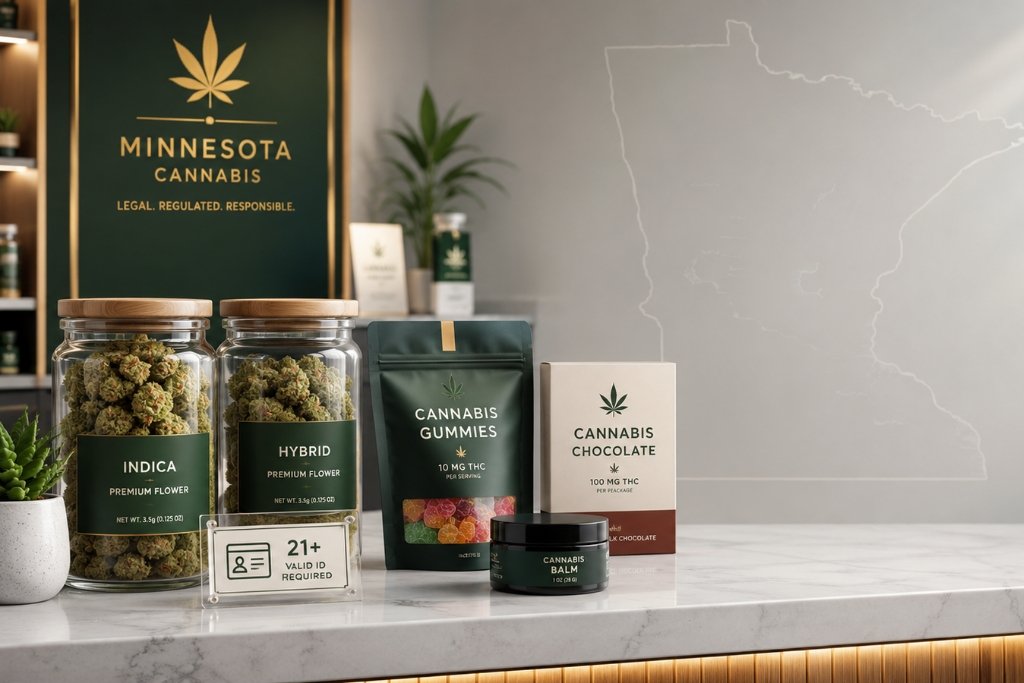
Did consumers know that Minnesota became the 23rd state in the nation to legalize adult-use marijuana? The gap between personal decriminalization and the launch of non-tribal licensed retail sales still stretched for over two years. On May 30, 2023, Governor Tim Walz signed House File 100 into law. The law established a highly progressive and localized framework for Minnesota cannabis. This historic shift decriminalized personal possession and home cultivation starting August 1, 2023. However, the complex bureaucratic transition delayed recreational adult-use service at state-licensed, non-tribal dispensaries until the fall of 2025.
As the state navigates a high-stakes commercial scale-up phase throughout 2026, residents, college students, and tourists ask a common question. Is weed legal in Minnesota? To understand whether is weed legal in Minnesota, one must look beyond the basic headline. Consumers also need to analyze the detailed legal guidelines, purchase limits, and market developments defining the modern landscape.
What is Minnesota cannabis?
In basic terms, Minnesota cannabis refers to any product derived from the Cannabis sativa plant. These products contain tetrahydrocannabinol (THC), cannabidiol (CBD), or other cannabinoids regulated under Chapter 342 of the Minnesota Statutes. This comprehensive legal category encompasses three distinct operational sectors. They include registered medical cannabis, adult-use recreational marijuana, and lower-potency hemp-derived consumables. The Office of Cannabis Management (OCM) oversees all Minnesota cannabis licenses, product safety rules, and retail compliance.
To answer the question, is weed legal in Minnesota, one must distinguish between high-potency marijuana and lower-potency hemp-derived products. Low-potency hemp products include THC seltzers and gummies containing up to 5 milligrams of THC per serving. These products became legal under a unique 2022 law. Traditional restaurants, bars, and breweries sell them widely. Conversely, adult-use recreational marijuana includes curated flower, vapes, and advanced concentrates like liquid diamonds.
These products must follow much stricter packaging, lab-testing, and distribution rules. For example, liquid diamonds represent a premium concentrate. It consists of highly pure tetrahydrocannabinolic acid (THCA) crystals melted down and enriched with natural plant terpenes. Terpene profiles refer to the organic aromatic compounds that determine a strain’s distinct flavor, aroma, and therapeutic effects. They help guide consumers to tailor their purchases.
Why the Legality of Marijuana Matters to Consumers
The formalization of the legal marketplace has profound social, economic, and practical implications for consumer groups across the United States. Understanding the evolution of Minnesota cannabis helps consumers make informed, legal decisions while traveling or residing in the state. For many years, marijuana prohibition led to severe racial disparities in arrest rates. It also created long-term criminal records for minor possession. The state has directly addressed this systemic issue through automatic expungement provisions. These provisions clear tens of thousands of non-violent, misdemeanor-level cannabis convictions from public records.
For beginners and college students, knowing is weed legal in Minnesota provides clarity. It also reduces the anxiety of potential law enforcement encounters. Understanding that is weed legal in Minnesota means personal possession is decriminalized helps adults 21 and older. They can legally transport up to 2 ounces of flower in public spaces. For the seasoned cannabis enthusiast, the regulated craft market ensures unprecedented product safety and strain transparency. Licensed state facilities must test every legal batch. This testing verifies cannabinoid potency and screens for harmful contaminants like heavy metals, mold, and residual chemical solvents. Furthermore, registered medical cannabis patients benefit from tax-exempt therapeutic access and dedicated product reserves. These protections shield vulnerable individuals from recreational supply shortages.
Key Features of Minnesota cannabis Regulations
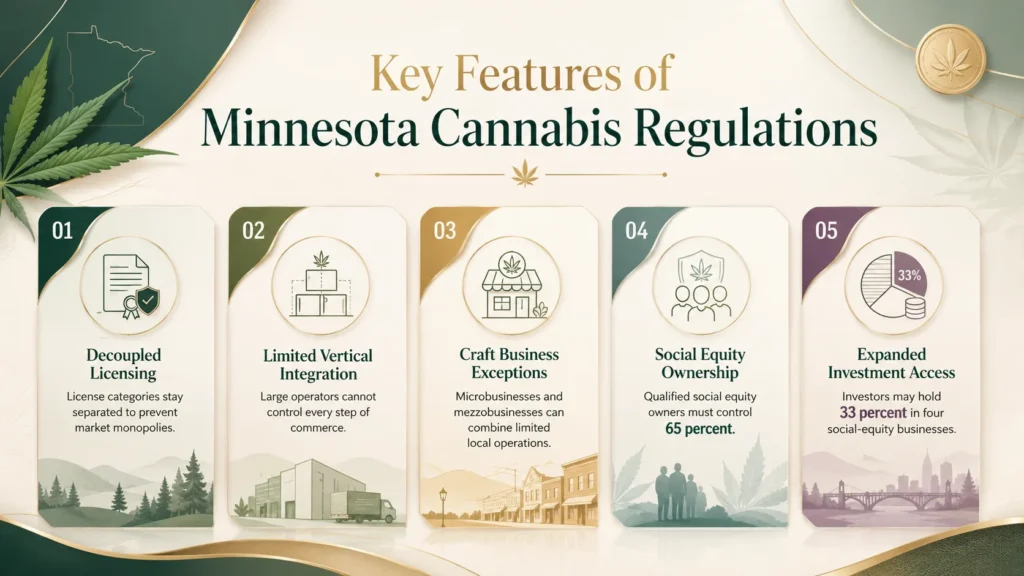
Minnesota’s cannabis licensing system is designed to keep the market local, competitive, and equity-focused.
- Decoupled licensing model: Standard cannabis business licenses are separated to prevent large multi-state operators from controlling the full supply chain.
- No vertical control for major operators: A large-scale cultivator cannot also operate a retail dispensary chain, and a manufacturer cannot run a testing laboratory.
- Craft-business exceptions: Microbusinesses and Mezzobusinesses may combine limited cultivation, manufacturing, and one retail operation under a single license.
- Social equity ownership rule: Designated social equity licenses require 65% ownership by eligible applicants from communities impacted by cannabis prohibition.
- Expanded investment access: In May 2026, Minnesota raised the passive investment limit from 10% to 33% for up to four social equity businesses.
- Local entrepreneur protection: This change helps social equity operators raise startup capital while maintaining operational control.
Evaluating the Pros and Cons of Minnesota Cannabis State Rules
To understand how the current regulations impact daily consumers and business operators, one can analyze the structured comparison below:
These distinct parameters show that the state has successfully established an equitable foundation. However, early-stage supply constraints continue to affect product availability and consumer pricing.
How the Market Operates: Step-by-Step Purchasing and Cultivation
To properly utilize the benefits of this law, understanding how is weed legal in Minnesota in a practical sense is vital. Consumers must follow specific legal steps to purchase, transport, and consume products safely within state lines.
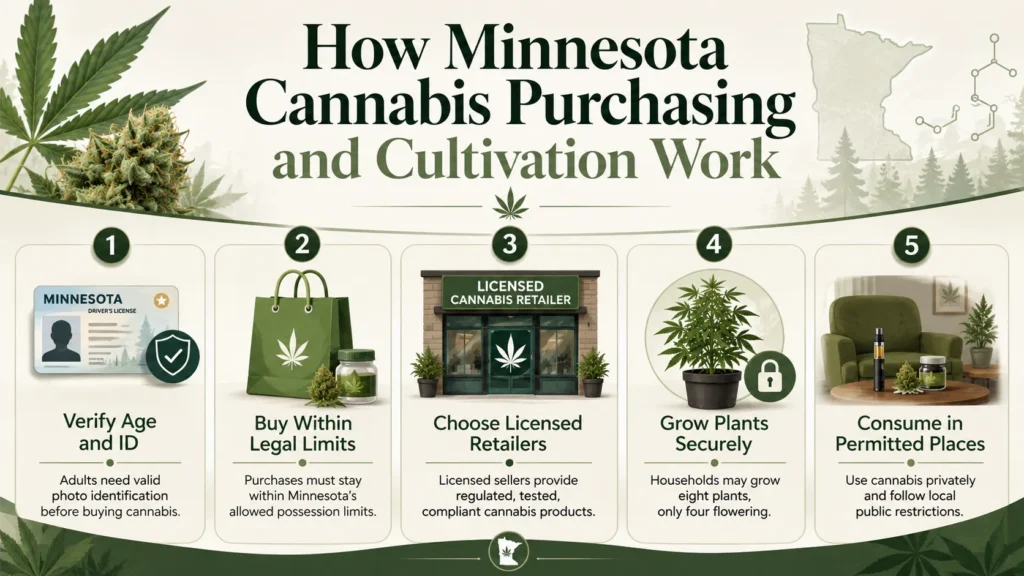
Step 1: Confirm Age and Identity
Any consumer wishing to purchase recreational cannabis must be at least 21 years of age. Retailers require a valid, government-issued photo identification prior to entry. This identification can include a state driver’s license or passport. There is no requirement to be a state resident to make a purchase.
Step 2: Navigate Legal Purchase Limits
Adults 21 and older can purchase up to 2 ounces of dry cannabis flower. They can also purchase 8 grams of THC concentrates. They can purchase up to 800 milligrams of THC-infused edible products per single transaction. The state does not enforce daily or weekly transaction caps. The purchase limits apply strictly on a per-transaction basis.
Step 3: Source from Licensed Outlets
Purchasing legally is a major component of how is weed legal in Minnesota. Consumers can obtain products from state-licensed adult-use dispensaries, tribal dispensaries, or licensed lower-potency hemp retailers. By February 2026, 96 non-tribal retail locations were active across the state. For absolute safety and quality, consumers can use a trusted local provider like Weed In Minnesota Dispensary & Weed Delivery. This choice ensures access to certified, compliant products.
Step 4: Follow Home Cultivation Rules
Adults can legally grow up to eight cannabis plants per household. A household may keep a maximum of four mature, flowering plants active at any single time. Adults 21 or older must cultivate these plants at their primary residence. They must keep the plants within a fully enclosed, locked space. The plants cannot be visible to the general public.
Step 5: Adhere to Public Consumption Laws
Another critical dimension of how is weed legal in Minnesota relates to consumption locations. State rules prohibit smoking or vaping cannabis in indoor public places. They also prohibit it in bars, restaurants, school zones, state correctional facilities, public parks, and transit vehicles. State law permits outdoor smoking on sidewalks where tobacco is permitted. However, local municipal ordinances in cities like Apple Valley have banned public use entirely. These rules limit consumption strictly to private property. Driving under the influence of cannabis remains a severe criminal offense.
Comparing Medical and Recreational Systems
Minnesota is simplifying how medical and recreational cannabis businesses operate.
- Medical and recreational systems were once separate: In the past, businesses had to keep medical cannabis and adult-use cannabis operations apart. This meant separate facilities, security systems, and cultivation spaces.
- The 2026 omnibus bill changed that: SF 4401 allows licensed cannabis businesses to handle medical and adult-use products within a more unified system.
- A new license starts in 2027: Beginning January 1, 2027, Minnesota will replace the old “medical combination business” license with a broader cannabis macrobusiness license.
- Macrobusinesses can do more under one license: These businesses may grow, process, transport, and sell cannabis if they receive the proper state endorsements.
- Cultivation limits still protect the craft market: Indoor cultivation space remains capped so large operators cannot dominate the market too easily.
- Medical patients still receive special protections: Licensed businesses must keep certain medical cannabis products available for registered patients.
- Patient orders receive priority: The updated system is designed to protect medical access while the recreational market continues growing.
Cannabis Program Distinction
To help consumers understand the practical differences between these two systems, the table below outlines the core operational distinctions:
Market Realities: Supply Dynamics and Minnesota cannabis Retail Data
The commercial launch of Minnesota cannabis dispensaries in late 2025 marked a massive turning point for the local economy. However, economists point to several unique, early-stage market dynamics when asking is weed legal in Minnesota. Federal law still classifies cannabis as a Schedule I controlled substance. As a result, products cannot legally cross state lines. Every ounce of flower sold in Minneapolis or St. Paul must grow within state boundaries. Operators must also harvest and process it inside Minnesota.
This state-bound supply constraint has created a major supply-and-demand mismatch. Strict initial limits on cultivation canopy have added more pressure. In early 2026, wholesale cannabis flower prices surged past $4,500 per pound. These costs resulted in premium retail prices for consumers. To stabilize the market, the state has actively leveraged tribal-state synergy. The state signed cooperative compacts with sovereign tribal nations, such as the Red Lake Nation and the Bois Forte Band of Chippewa. These agreements authorize tribal enterprises to operate off-reservation dispensaries. They also allow tribal enterprises to supply wholesale cannabis products to non-tribal retailers. This arrangement serves as a critical supply safety net. It helps while local microbusinesses and mezzobusinesses scale up their cultivation facilities.
Introduction of Cannabis Partnership Models
Additionally, the state has pioneered unique public-private partnership models. On February 7, 2026, the city of Anoka opened the first municipally-owned cannabis dispensary in the United States. Following this precedent, the city of Osseo approved a municipal retail store in mid-2026. It partnered with Voyageur Cannabis Services to manage daily retail operations. Under this model, the local government holds the cannabis license and collects the profits. It uses retail revenue directly to fund local public services and reduce the tax burden on residents.
Furthermore, the state has successfully integrated the massive, pre-existing hemp-derived THC market. A federal ban on hemp products containing more than 0.4 milligrams of THC approaches on November 12, 2026. This pending ban left many local hemp business owners facing financial ruin. The May 2026 omnibus bill effectively saved the local hemp industry. It allows hemp-derived businesses to obtain standard cannabis licenses without shutting down their current low-potency operations. This structure provides a seamless “bridge” to long-term compliance.
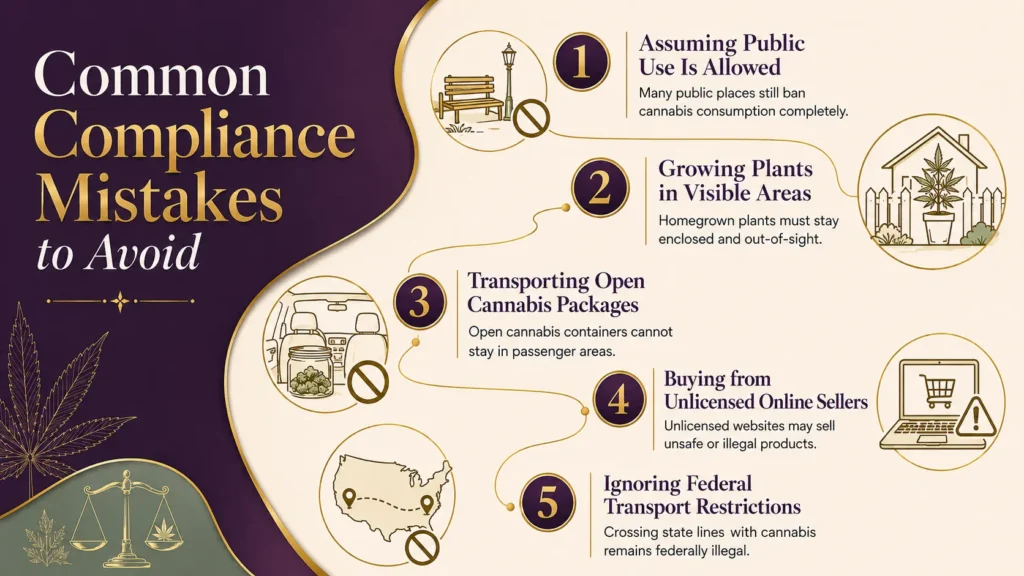
Common Compliance Mistakes to Avoid
Consumers should avoid assuming that legal cannabis use is permitted everywhere in Minnesota.
- Public use is still restricted: Smoking or consuming cannabis in municipal parks, public beaches, restaurant patios, and other prohibited public spaces remains illegal.
- Local fines may apply: Some suburban communities enforce stricter public-use rules and may issue fines for violations.
- Home cultivation must stay private: Growing cannabis in a visible backyard garden violates state law if neighbors or passersby can see the plants.
- Plants must be secured: Minnesota requires home cultivation to occur in a locked, fully enclosed space.
- Open-container rules apply: Carrying open cannabis packages in the passenger area of a vehicle violates state open-container laws, similar to alcohol rules.
- Avoid unlicensed online sellers: Out-of-state shipping websites may sell synthetic, untested, or mislabeled cannabis products.
- Interstate transport remains illegal: Taking cannabis across state lines is still a federal offense, even if it was purchased legally in Minnesota.
- Buy from licensed local sources: Consumers should purchase only from licensed dispensaries or verified local delivery services, such as Weed In Minnesota Dispensary & Weed Delivery.
Frequently Asked Questions
Q1: is weed legal in Minnesota for out-of-state tourists?
A: To determine how is weed legal in Minnesota for visitors, any adult aged 21 or older needs valid government-issued photo identification. That adult can legally purchase and possess cannabis within the state. There are no residency requirements. Out-of-state visitors enjoy the same transactional purchase limits as local residents. However, taking legally purchased cannabis across state lines remains a federal crime.
Q2: What are the exact personal possession and transport limits?
A: Under state statutes, adults can legally possess up to 2 ounces of dry cannabis flower in a public space. They can keep up to 2 pounds of flower inside their private residence. They can also possess up to 8 grams of concentrate. Edible products can contain up to 800 milligrams of THC.
Q3: When did recreational dispensaries officially open in the state?
A: Possession became legal in August 2023. However, state-licensed, non-tribal dispensaries did not begin recreational sales until the fall of 2025. Tribal-owned dispensaries on sovereign reservation land have operated since 2023. The retail landscape has expanded rapidly through 2026 with new municipal and private store openings.
Q4: is weed legal in Minnesota to consume in multi-family apartments?
A: No. The Minnesota Clean Indoor Air Act and state regulations explicitly prohibit smoking or vaping recreational cannabis in multi-family housing units. This includes private apartments, balconies, and shared patios. The only exception applies to registered medical cannabis patients who hold valid credentials.
Q5: How do local municipalities regulate retail store density?
A: Local municipal governments cannot entirely ban cannabis businesses from operating within their boundaries. They can enforce strict local registration, zoning, and density caps. By law, cities must allow a minimum of one retail cannabis license for every 12,500 residents. Once this cap is met, municipalities may opt out of issuing additional licenses.
Conclusion: The Path Forward for Minnesota cannabis
In summary, the question is weed legal in Minnesota is easy to answer. However, the detailed regulatory framework requires clear knowledge of possession boundaries, consumption laws, and market shifts. The structural evolution of Minnesota cannabis shows a progressive effort to balance economic opportunity, social equity, and public safety. The state integrated the medical and adult-use supply chains under SF 4401. It also established a regulatory bridge for local hemp operators. Together, these steps created a resilient model designed for long-term growth.
For those looking to confidently celebrate the fact that is weed legal in Minnesota, a premier local service can help. Weed In Minnesota Dispensary & Weed Delivery ensures access to the highest quality Minnesota cannabis. It operates as a trusted, customer-centric destination for the Twin Cities community. This local industry authority prioritizes advanced cannabis education. It guides consumers through detailed terpene profiles and precise strain lineages to guarantee a highly personalized experience. The dispensary’s curated inventory features premium curated flower, high-quality vapes, and advanced concentrates such as liquid diamonds.
All products undergo strict quality control. With frictionless, fast delivery across the Twin Cities, the service offers major convenience. It includes free delivery on orders over $5 and a fully compliant, 21+ adult-use framework. Weed In Minnesota Dispensary & Weed Delivery represents the ultimate destination for safe, legal, and satisfying cannabis access. We encourage consumers to explore the online menu and place an order today to experience top-tier local craft cannabis.
Frequently Asked Questions
In basic terms, Minnesota cannabis refers to any product derived from the Cannabis sativa plant. These products contain tetrahydrocannabinol (THC), cannabidiol (CBD), or other cannabinoids regulated under Chapter 342 of the Minnesota Statutes. This comprehensive legal category encompasses three distinct operational sectors.
The formalization of the legal marketplace has profound social, economic, and practical implications for consumer groups across the United States. Understanding the evolution of Minnesota cannabis helps consumers make informed, legal decisions while traveling or residing in the state. For many years, marijuana prohibition led to severe racial disparities in arrest rates.
Minnesota’s cannabis licensing system is designed to keep the market local, competitive, and equity-focused. Decoupled licensing model: Standard cannabis business licenses are separated to prevent large multi-state operators from controlling the full supply chain. No vertical control for major operators: A large-scale cultivator cannot also operate a retail dispensary chain, and a manufacturer cannot run a testing laboratory.
To understand how the current regulations impact daily consumers and business operators, one can analyze the structured comparison below: Structural Advantages of the State Framework Operational Challenges and Drawbacks Robust Social Equity Focus: The 65% ownership requirement protects independent, local minority-owned businesses from corporate takeovers. Severe Supply Bottlenecks: Limited early cultivation licensing has driven wholesale flower prices past $4,500 per pound in 2026. Reduced Municipal Responsibility: Minnesota repealed its local cannabis aid program, so cannabis tax revenue is no longer directly shared with municipalities starting in 2026.
To properly utilize the benefits of this law, understanding how is weed legal in Minnesota in a practical sense is vital. Consumers must follow specific legal steps to purchase, transport, and consume products safely within state lines. Step 1: Confirm Age and Identity Any consumer wishing to purchase recreational cannabis must be at least 21 years of age.